RAADS-R Test: Your Guide to Autism Self-Assessment
Introduction: Understanding the RAADS-R Test
The RAADS-R test, or Ritvo Autism Asperger Diagnostic Scale-Revised, is an 80-item self-report questionnaire designed to help adults explore autism-related traits. It looks at patterns in social relatedness, language, sensory-motor experiences, and circumscribed interests.
The test can be useful when you are trying to make sense of long-standing experiences such as social exhaustion, sensory overload, literal communication, intense interests, a strong need for routine, or years of masking. It gives structure to self-reflection, but it does not provide a medical diagnosis by itself.
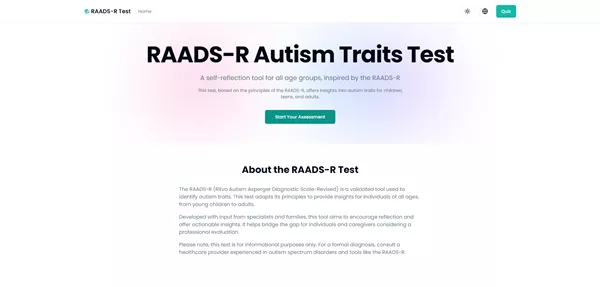
At RAADS-R.net, we offer a streamlined online version of the test so users can explore their traits privately and conveniently. Click here to start the RAADS-R test now and use the result as a starting point for reflection, support planning, or a professional conversation.
What is the RAADS-R Test?
The RAADS-R test is a scientifically studied adult autism screening tool. Unlike a formal diagnostic assessment administered by a clinician, it is a self-guided questionnaire that helps identify traits commonly associated with autism spectrum profiles.
It evaluates four primary areas:
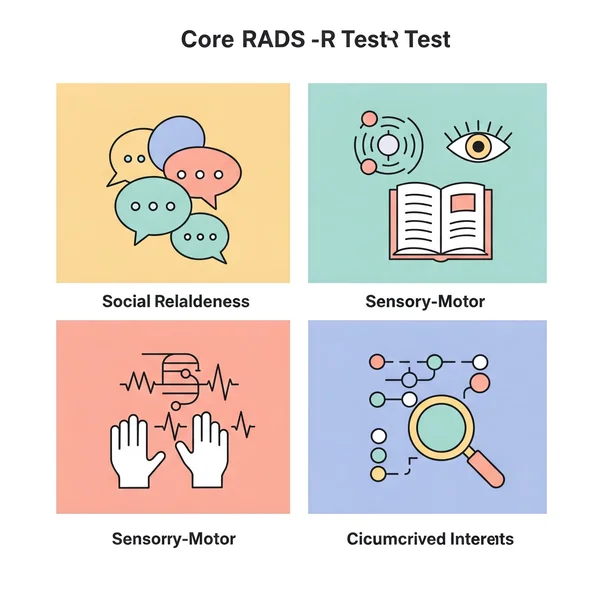
- Social Relatedness: Patterns in social connection, reciprocity, group conversation, social timing, and understanding unspoken expectations.
- Language Use: Differences in literal interpretation, indirect meaning, conversational rhythm, expressive language, and receptive communication.
- Sensory-Motor Responses: Heightened or reduced sensitivity to sound, light, texture, smell, movement, body awareness, or busy environments.
- Circumscribed Interests: Focused interests, routines, preference for sameness, repetitive patterns, and distress around unexpected change.
Social relatedness items are not only about whether someone wants relationships. They can reflect how much effort it takes to understand social timing, enter conversations, read indirect expectations, maintain reciprocal interaction, or recover after social demands.
Language items can matter even for adults who speak fluently. The RAADS-R may capture differences in literal interpretation, processing implied meaning, understanding jokes or sarcasm, choosing precise words, or feeling misunderstood because others read tone or intent differently than intended.
Sensory-motor items look at daily body and sensory experiences that are easy to minimize from the outside. Noise, light, touch, texture, smell, crowded places, coordination, or movement differences may affect energy, comfort, attention, and recovery time.
Circumscribed interests include focused interests, repetitive patterns, routines, and preference for sameness. These traits can be strengths and sources of regulation, but they may also become stressful when interruptions, uncertainty, or sudden changes make daily life harder.
While the RAADS-R test cannot replace a professional diagnosis, it can offer a foundational understanding of potential autistic traits and help you decide what to explore next.
Purpose and Scope of the RAADS-R
The RAADS-R test bridges the gap between private self-questioning and professional evaluation. Its main purposes include:
- Raising Awareness: Helping adults recognize patterns they may have normalized, masked, or misunderstood for years.
- Guiding Next Steps: Encouraging people with significant traits or support needs to consider professional evaluation when appropriate.
- Empowering Self-Reflection: Offering language for social, sensory, communication, and routine-related experiences.
The RAADS-R is most useful when treated as a reflection tool. A score can help you notice patterns, but the meaning of those patterns depends on your history, daily functioning, current stress, co-occurring conditions, and real-life examples.
Understanding RAADS-R Test Scores
The RAADS-R test generates a numerical score based on responses to 80 questions. The total score reflects how strongly your answers align with autism-related traits measured by the questionnaire.
Higher scores generally indicate stronger endorsement of traits associated with autism on this measure. Lower scores generally indicate fewer endorsed traits. However, a score is not a complete explanation of your life. Self-report tools depend on memory, question interpretation, self-awareness, masking, mood, and current stress.
What Does a RAADS-R Score Mean?
Scores are commonly interpreted around the threshold of 65:
- Below the Threshold: Fewer autism-related traits are endorsed on this measure, though lived concerns may still deserve attention.
- Borderline or Moderately Elevated Scores: Some traits may be present, but context matters, especially when ADHD, anxiety, trauma, burnout, or stress may overlap.
- Higher Scores: A stronger pattern of endorsed autistic traits, often worth reviewing alongside domain patterns and real-life examples.
Example: A score of 160 or higher is very elevated on the RAADS-R scale. It may strongly suggest autism-related traits, but it is still not a formal diagnosis. It should be used to organize examples and decide whether professional evaluation would be helpful.
Interpreting Your RAADS-R Results
Understanding your RAADS-R results is most useful when you look beyond the total number.
- Typical Score Ranges:
- Below 65: Below the commonly cited threshold.
- 65-130: Elevated or borderline-to-moderate range where context matters.
- Above 130: Stronger alignment with autism-related traits on this questionnaire.
- Domain Pattern: Review whether your score was shaped more by social relatedness, language, sensory-motor experiences, circumscribed interests, or a broad mix of all four.
- Practical Meaning: Ask where the traits show up in daily life, what they cost you, and what kind of support would help.
If your results suggest high ASD traits, click here to review your test result and use it as a starting point for clearer self-understanding.
Accuracy and Reliability of the RAADS-R Test
The RAADS-R test is widely discussed because it has research support, especially in adult autism assessment contexts. It is best understood as a screening aid and self-report measure, not a stand-alone diagnostic instrument.
How Accurate is the RAADS-R Test?
In the original international validation study, the RAADS-R was tested with 779 participants, including 201 autistic adults and 578 comparison participants. The study reported:
- Sensitivity: 97%, meaning it identified many autistic participants in that study sample.
- Specificity: 100%, meaning comparison participants in that study were not classified above the threshold.
- Test-retest reliability: r = .987, suggesting strong consistency over time in the study context.
These metrics support the RAADS-R as a useful pre-screening and adjunct clinical tool. However, results are most valuable when shared with a qualified professional during a broader diagnostic process. Learn more about autism spectrum conditions from the National Institute of Mental Health (NIMH).
Trustworthiness and Limitations
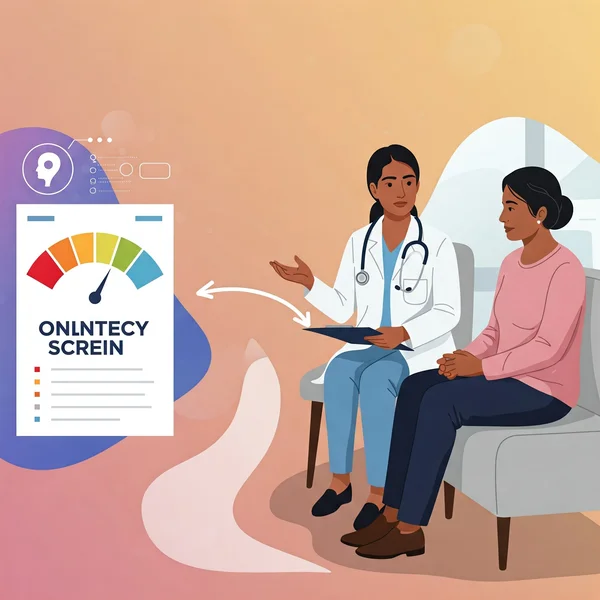
Although the RAADS-R can be useful, it has important limitations:
- Not a Diagnosis: Results should guide reflection or further evaluation, not serve as definitive proof of autism.
- Self-Reporting Bias: Accurate results depend on honest, careful answers and how you understand each question.
- Masking Effects: Some people answer based on how they appear to others rather than the internal effort required.
- Overlap With Other Conditions: ADHD, anxiety, trauma, OCD, depression, sleep problems, and burnout can overlap with some questionnaire items.
- No Professional Interaction: Online self-administration lacks the clarification, developmental history, and differential diagnosis involved in full assessment.
Later clinical research has been more cautious than the original validation study, especially in referral settings where many people already have overlapping traits or complex histories. The balanced conclusion is that the RAADS-R can support self-reflection and clinical discussion, but it should not be used alone to confirm or rule out autism.
Target Audience for the RAADS-R Test
The RAADS-R test is specifically designed for adults exploring potential autism spectrum traits. It may be useful for:
- Self-Reflective Adults: People aged 18 and older who suspect they may be autistic but have never been formally diagnosed.
- Adults Missed in Childhood: People who masked, copied social behavior, performed well academically, or were labeled anxious, shy, sensitive, gifted, difficult, or obsessive instead.
- Supportive Family Members: Loved ones encouraging someone to better understand their neurodiversity.
- Healthcare Professionals: Clinicians using the RAADS-R as supplementary information within a broader assessment process.
Common adult signs that may lead someone to use the RAADS-R include social fatigue, relying on scripts, difficulty with vague instructions, sensory overload, strong routines, intense interests, shutdowns after demanding environments, or a long-standing feeling of being different without knowing why. These signs do not prove autism on their own, but they can show why structured self-screening may be worth exploring.
At RAADS-R.net, the test is accessible for anyone looking to gain initial insight into their unique profile privately and conveniently.
Who Should Take the RAADS-R Test?
The RAADS-R test is ideal for adults who:
- Are Undiagnosed: Individuals who suspect they may be autistic but have not had a formal evaluation.
- Seek Insight: Anyone noticing long-standing challenges in communication, social relationships, sensory responses, routine needs, or focused interests.
- Want a Structured Starting Point: People who want to organize experiences before deciding whether support or assessment would help.
Note: The RAADS-R test is not designed for young children or for people requiring immediate clinical intervention. If you are concerned about a child, use age-appropriate screening tools and professional guidance instead. Take the RAADS-R test today and gain useful insight into your traits.
Age Group Considerations
The RAADS-R is optimized for adults aged 18 and above. Key considerations include:
- Young Adults (18-30): Early recognition of traits can help with education, work, relationships, sensory planning, and self-advocacy.
- Middle-Aged Adults (30-50): Understanding neurodiversity can reframe long-standing patterns, masking, burnout, and support needs.
- Older Adults (50+): Identifying autistic traits later in life can provide context for past experiences and guide accommodations or support.
Regardless of age, the result is most useful when connected to real examples from daily life rather than treated as a label by itself.
Comparison with Other Autism Assessments
The RAADS-R test is distinct from other autism evaluations, such as:
- Autism Spectrum Quotient (AQ): A shorter self-report tool that measures autistic traits but does not provide the same RAADS-R subscale structure.
- Adult Asperger's Assessment (AAA): A clinician-administered assessment process, not a quick self-report test.
- Autism Diagnostic Observation Schedule (ADOS): A standardized observational tool used by trained professionals as part of formal assessment.
The RAADS-R can be easier to access than clinician-administered assessments, but that accessibility is also why its limits matter. It can help you begin, organize, and communicate your experiences. It cannot replace clinical judgment.
RAADS-R vs. Other Autism Tests
Key differences include:
- Accessibility: The RAADS-R is self-administered and can be used as an initial screening step.
- Detailed Subscales: The test evaluates social relatedness, language, sensory-motor behaviors, and circumscribed interests.
- Immediate Results: Users can receive a score without waiting for a clinical appointment.
- Adult Focus: The questionnaire is designed around adult traits, including people whose autism may have been missed earlier.
Explore the RAADS-R test to discover its role as a first step in adult autism self-assessment.
How to Take the RAADS-R Test
Taking the RAADS-R test online is straightforward:
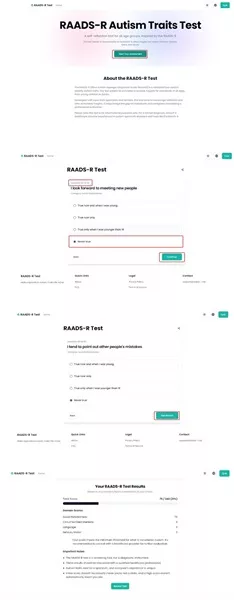
- Visit the Website: Go to RAADS-R.net.
- Start the Test: Click "Begin Test" to access the self-report questionnaire.
- Answer Honestly: Respond to 80 questions across four subscales, reflecting your real experiences and traits.
- Submit Your Responses: Complete the test at your own pace and submit when ready.
- Review Your Results: Receive your score and use it to identify areas where traits may align with autism spectrum profiles.
Your score report can help you identify which areas contributed most to your result, such as social relatedness, language, sensory-motor responses, or circumscribed interests.
Steps to Complete the RAADS-R Test Online
Here is how to complete the test efficiently:
- Preparation: Choose a quiet, distraction-free environment.
- Read Carefully: Give yourself time with each question, especially items about childhood and adulthood.
- Navigate Subscales: Respond to questions across social relatedness, language, sensory-motor, and circumscribed interests.
- Be Honest: Answer based on your internal experience, not only how well you can perform or mask externally.
- Review Results: Use your score to decide whether self-reflection, support planning, or professional evaluation is the right next step.
Click here to begin your RAADS-R test and gain clarity about your neurodiversity.
What to Expect During the Test
The RAADS-R test is designed to be user-friendly:
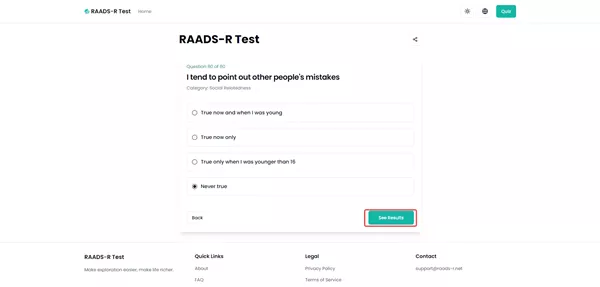
- Length: The test contains 80 questions and often takes about 20-30 minutes to complete.
- Format: Questions ask you to choose from response options that reflect whether a statement applies now, in childhood, both, or not at all.
- Outcome: Results are presented after completion, highlighting your overall score and its implications.
If you mask heavily, pause before answering. Ask what a situation costs you internally, not only whether you can appear to manage it.
Next Steps After Taking the RAADS-R Test
Completing the RAADS-R test is the first step in better understanding your neurodiversity. After your result, slow down and connect the score with your actual life.
Review Your Results
- Understand Your Score: A score of 65 or higher can suggest autism-related traits, but it is not a diagnosis.
- Identify Patterns: Look at subscale results to identify areas such as social relatedness, sensory-motor responses, language, or circumscribed interests.
- Write Down Examples: Note situations from work, school, relationships, sensory environments, routines, childhood memories, and recovery time.
- Notice Unclear Items: Save questions that felt hard to answer or poorly matched to your experience.
Consider Professional Evaluation
The RAADS-R test is a screening tool and not a diagnostic instrument. If your score suggests autistic traits, or if these patterns affect daily life, consider consulting a clinical psychologist, psychiatrist, autism specialist, or another qualified professional for a comprehensive evaluation.
Professional assessment may be especially helpful if you need diagnostic clarity, documentation for accommodations, support planning, or help distinguishing autism from ADHD, anxiety, trauma, OCD, depression, or burnout.
Learn more about the RAADS-R test process here.
Interpreting Results: When to Seek Professional Help
The RAADS-R test provides valuable insights but cannot replace a formal diagnosis. For professional guidance, review the CDC's recommendations on autism diagnosis and treatment.
Consider professional assistance when:
- High Scores (65 or Above): Your score indicates notable autistic traits and you want a fuller evaluation.
- Ongoing Challenges: Social communication, sensory sensitivity, routines, burnout, or masking affect daily life.
- Desire for Clarity: A formal diagnosis may help with accommodations, therapy, support services, or self-understanding.
Key Questions for Professionals
When consulting a specialist, consider asking:
- What does my RAADS-R score suggest, and what does it not prove?
- What additional tests, interviews, or developmental history would you recommend?
- How do we consider ADHD, anxiety, trauma, depression, or burnout alongside autism?
- What supports or accommodations might help even before diagnosis is complete?
How the RAADS-R Can Inform Next Steps
The RAADS-R test acts as a starting point for understanding your neurodiversity:
- Self-Awareness: Gain insight into areas where autistic traits may affect your life.
- Resource Identification: Use your results to explore support groups, workplace accommodations, sensory strategies, or therapy.
- Professional Guidance: Share your score and examples with clinicians to support a fuller assessment conversation.
Practical next steps can be simple and low-risk. You might reduce sensory load with quieter spaces, headphones, softer clothing, or planned recovery time. You might ask for written instructions, clearer expectations, meeting notes, or direct feedback. You might track which situations cause shutdown, overload, social exhaustion, or stress around change. The goal is to translate a screening result into support needs, not to force certainty from one score.
Take the next step on your autism assessment journey.
Conclusion: Empowering Self-Understanding
The RAADS-R test can be an empowering tool for self-awareness. It offers a structured way to explore autism spectrum traits, especially for adults who were missed earlier in life or who have spent years masking. While not diagnostic, it can be a valuable first step toward understanding yourself and accessing support if needed.
Taking Control of Your Autism Assessment Journey
By taking the RAADS-R test, you can:
- Recognize Strengths: Understand how your traits shape focus, sensitivity, interests, honesty, routines, and ways of processing the world.
- Identify Challenges: Notice areas where support or accommodations may improve daily life.
- Take the First Step: Begin a self-discovery process that can lead to greater clarity, acceptance, and practical support.
Discover your neurodiversity today.
The Importance of Professional Diagnosis
A formal autism diagnosis may provide:
- Clarity and Validation: Confirming whether your lifelong pattern fits autism.
- Access to Resources: Supporting eligibility for accommodations, services, or tailored care.
- Personalized Interventions: Helping you navigate sensory, social, communication, routine, and burnout-related challenges.
Sharing your RAADS-R results with a qualified professional can make the diagnostic conversation more concrete. Bring the score, but also bring examples. Your lived patterns are more useful than the number alone.
Frequently Asked Questions (FAQ)
Is the RAADS-R Test Used by Doctors?
Yes, the RAADS-R may be used by clinicians as part of a broader diagnostic evaluation. However, it is not a standalone diagnostic tool and should be interpreted with developmental history, interviews, observation, and clinical judgment.
What is a 160 RAADS Score?
A RAADS-R score of 160 is very elevated and suggests a strong pattern of autism-related traits on this questionnaire. It is meaningful context, but it still does not confirm autism by itself. A qualified professional can help interpret the result alongside your history and current support needs.
Can the RAADS-R Test Diagnose Autism?
No. The RAADS-R is a screening tool that highlights potential traits consistent with autism. Only a qualified professional can provide a formal diagnosis after a broader assessment.
What is the Difference Between RAADS-R and Other Tests?
The RAADS-R focuses on adult self-reported experiences across social relatedness, language, sensory-motor patterns, and circumscribed interests. Other tools, such as ADOS, require clinical observation and professional administration.
Additional Resources
Online Autism Test for Adults
Explore online tools like the RAADS-R test as an initial step for understanding autism spectrum traits. Use them for reflection, not as a substitute for diagnosis.
Free Autism Screening Tools
At RAADS-R.net, we offer a free, user-friendly RAADS-R test to help adults recognize potential autism traits without cost barriers.
Taking the first step toward understanding your neurodiversity is simple: start the RAADS-R test today.