Autistic Wheel Explained: How to Read It and Map Your Needs
Want to see where you score?
Take the Free RAADS-R TestAn autistic wheel is a circular diagram that separates areas of autistic experience into sections. It can show differences across communication, sensory experiences, routines, and other areas without reducing a person to one overall ranking. To read one, check the section labels, find out what distance from the center means, and read the notes behind the shading.
This guide includes two worked examples that record support wanted in a particular setting. They are informal reflection aids, not validated questionnaires or medical assessments.
What Is an Autistic Wheel?
Also called an autism wheel or autism spectrum wheel, the diagram divides a circle into labeled sections. Different versions use different labels and scales: one might illustrate trait expression, another difficulties, and another support needs. Check the particular template before interpreting its shape.
Vanderbilt University's Frist Center for Autism and Innovation uses a color wheel in its explanation of the spectrum and also links to Rebecca Burgess's illustrated explanation. The six-section example here is a separate personal reflection design; its labels and scale are not a Vanderbilt assessment.
The National Institute of Mental Health describes autism as a spectrum because people have varied characteristics, needs, strengths, and challenges. A wheel can help illustrate that variation. It does not replace the clinical concept of the autism spectrum or assign an autism support level.
For a broader discussion of adult traits and developmental history, see our adult autism self-reflection guide. This article focuses on reading and using the diagram.
How to Read an Autism Wheel: Labels, Scale, and Notes
Start with four checks:
- What does each section describe? Communication and social situations, for example, may be separate sections even though they overlap in everyday life.
- What does the radius measure? A longer shaded section could mean more difficulty, stronger trait expression, or more support wanted. These meanings are not interchangeable.
- Which setting and date does it describe? A profile for a noisy meeting may differ from one for a quiet evening at home.
- What examples explain the marks? The drawing summarizes observations; the notes tell you what happened and what might help.
Colors help distinguish sections in the example below. They do not rank autism severity. The numbers and written notes carry the meaning, so the diagram can also be read in grayscale.
The scale used in these examples
Every section uses the same question: How much extra support would I like in this setting?
| Mark | Meaning in these examples | How to show it |
|---|---|---|
| 0 | I do not currently want extra support in this area. | Leave the section unshaded and write 0 in the notes. |
| 1 | An occasional adjustment would help. | Shade from the center to the first ring. |
| 2 | I would like a regular adjustment or practical help. | Shade from the center to the second ring. |
| 3 | I would like substantial or ongoing assistance. | Shade from the center to the outer ring. |
| Unsure | I need more information or time to reflect. | Leave the section unshaded and write U in it and in the notes. |
Zero is at the center; rings 1, 2, and 3 move outward. The numerals are informal reflection labels. A 3 is not clinical Level 3 autism, and a 0 does not mean an absence of autistic traits. Leave a separate note if the setting offers no opportunity to observe an area.
Keep Unsure separate from 0. Do not add the sections into a total, an “autism percentage,” or a comparison of who is “more autistic.” The numbers summarize support preferences, and the filled area is not a percentage scale.
The six reflection areas
Use these labels as starting points, or adapt them to your purpose:
| Section | What to record |
|---|---|
| Communication | Preferred ways of receiving and sharing information. |
| Social situations | Interaction demands, effort, and recovery time. |
| Sensory experiences | Inputs that are uncomfortable, helpful, or hard to notice. |
| Routine and change | Transitions, predictability, and advance notice. |
| Interests and repetition | Activities that help with enjoyment, focus, or regulation. |
| Planning and daily tasks | Getting started, sequencing steps, and practical assistance. |
These are personal reflection categories, not a diagnostic checklist or the four RAADS-R subscales. Planning difficulties, for example, can have multiple explanations. For the questionnaire's own categories, read our guide to RAADS-R domains.
Worked Example: One Person, Two Settings
Alex is a fictional adult using an autism wheel to prepare a support conversation. The two profiles below describe a work meeting and a quiet evening alone at home. The values are invented examples, not typical scores for autistic adults.
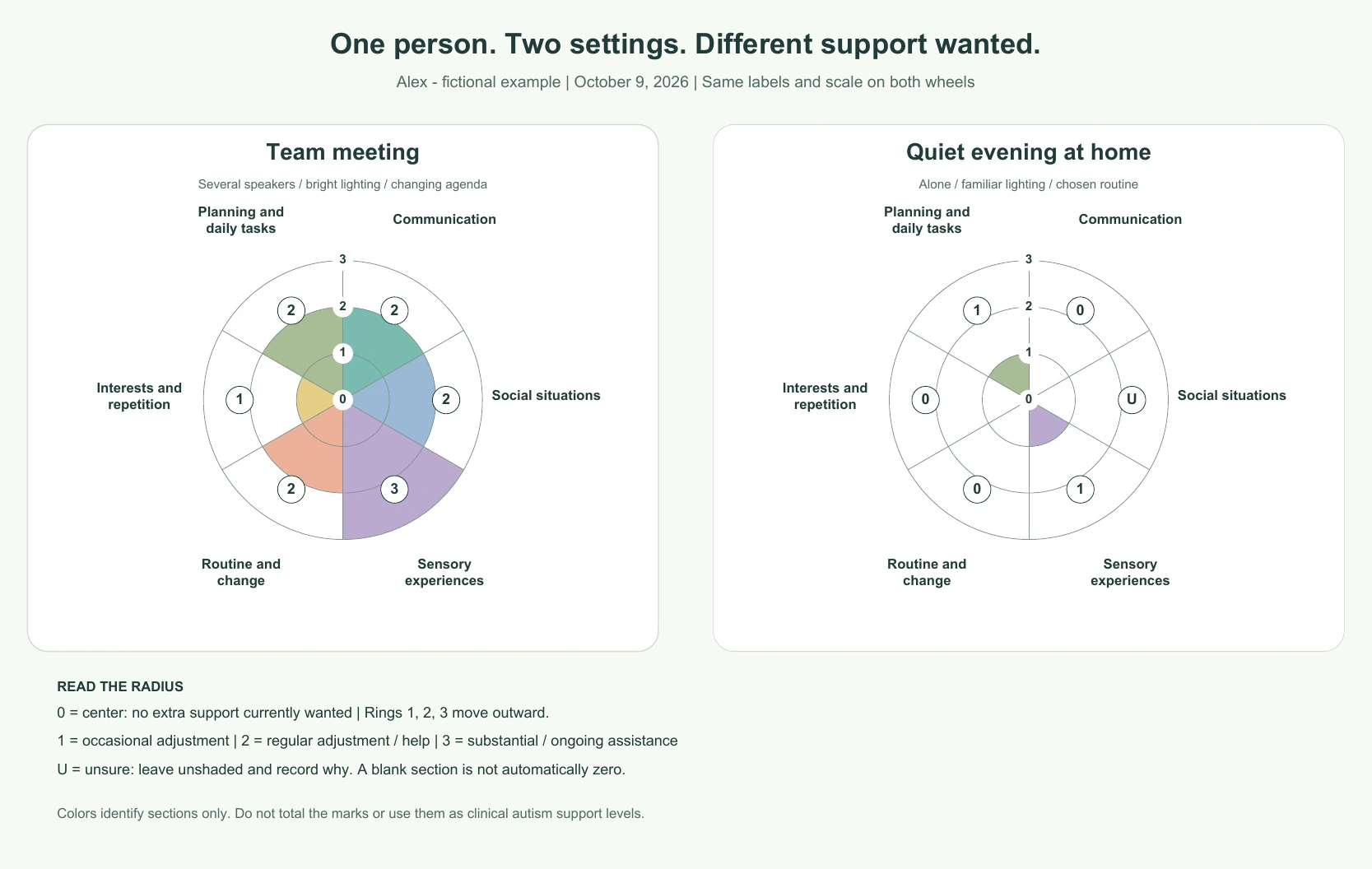
Read clockwise from the upper-right section: communication, social situations, sensory experiences, routine and change, interests and repetition, planning and daily tasks. Colors identify sections; radius shows support wanted. U means Unsure.
Alex's work meeting profile
Setting: a one-hour team meeting with several speakers, bright lighting, and an agenda that sometimes changes. Date: October 9, 2026.
| Section | Mark | Alex's observation | Support Alex would like |
|---|---|---|---|
| Communication | 2 | I lose track when several people give instructions at once. | One speaker at a time and written action items. |
| Social situations | 2 | I rehearse comments and need quiet recovery time afterward. | An option to contribute in writing and a break after the meeting. |
| Sensory experiences | 3 | Bright lights and overlapping voices make it hard to stay engaged. | A quieter room with adjustable lighting throughout the meeting. |
| Routine and change | 2 | Last-minute agenda changes make preparation difficult. | An advance agenda and written notice of changes. |
| Interests and repetition | 1 | A small, quiet fidget helps me concentrate. | Freedom to use it during discussion. |
| Planning and daily tasks | 2 | I struggle to turn a rapid discussion into a task sequence. | Written priorities, owners, and deadlines. |
The sensory section reaches ring 3 because Alex wants substantial environmental support for this meeting. Communication reaches ring 2 because Alex wants a regular adjustment. Neither mark measures intelligence, speaking ability, or overall autism severity.
Alex also records a strength: “I spot inconsistencies in project details when I have time to review them.” The scale does not measure strengths, so that observation belongs in a separate notes box.
Alex's quiet evening at home profile
Setting: an evening alone with familiar lighting, a planned routine, and time for a preferred hobby. Date: October 9, 2026.
| Section | Mark | Alex's observation | Support or follow-up |
|---|---|---|---|
| Communication | 0 | I can read and reply to messages at my own pace. | No extra support currently wanted in this setting. |
| Social situations | Unsure | I am alone, so this evening tells me little about interaction demands. | Leave the section unshaded and mark U; review after a quiet visit with a friend. |
| Sensory experiences | 1 | Street noise occasionally interrupts my concentration. | A quiet alternative space when needed. |
| Routine and change | 0 | I chose the order of activities and know what to expect. | No extra support currently wanted. |
| Interests and repetition | 0 | My preferred hobby is already available and helps me settle. | Keep access to the activity; no extra adjustment currently wanted. |
| Planning and daily tasks | 1 | I sometimes forget a household task while absorbed in my hobby. | An occasional reminder or short task list. |
The home profile has less shading because Alex wants less extra support in that setting. Familiar routines and control over the environment are already helping. The drawing does not establish that Alex's underlying traits changed, or that supports can be removed elsewhere.
The unshaded social section is also different from a 0: Alex has not observed enough to choose a number. That is why the U and the accompanying explanation matter.
Map Your Own Support Needs
To create your own autism wheel, draw a circle with six labeled sections and three rings, using the reflection areas and scale above. Then follow these steps:
- Name one setting and add the date. Be specific, such as “Monday team meeting,” rather than “my whole life.”
- Write observations before choosing numbers. Include what happened, the effort involved, and what helped. Leave a mark as Unsure when you need more information.
- Shade to the matching ring. Use the same question and scale for every section. Record 0 or U explicitly so an empty section is understandable.
- Add one support request and a strength. The drawing should lead to something useful beyond a pattern of colors.
- Compare notes across settings or dates. Note what changed in the environment, demands, or available support before interpreting a changed shape.
A blank autism wheel can organize observations without a diagnosis. It cannot establish why those experiences occur. Share only the sections you want to discuss; if someone helps you complete it, include your own account and preferred communication method.
Turn the Wheel Into a Specific Support Request
Alex chooses one meeting observation and one request: “When several people give instructions at once, I lose track of what I need to do. Could we finish with a written list of actions, owners, and deadlines?”
The useful sequence is setting → observation → requested adjustment → review. After a later meeting, Alex can record whether written action items helped, whether an additional change is needed, or whether the rating is still uncertain. A smaller shaded section is not a required outcome; the question is whether the support fits.
For broader advice on professional conversations and resources, see our next steps and support guide. If your main question is whether you are autistic, a qualified professional can consider developmental history and other explanations alongside your notes.
Autism Wheel Makers, Online Tests, and RAADS-R
An autism wheel maker displays information. An “autism wheel test online” may also ask questions and generate a profile, but the chart's appearance does not establish that its questionnaire or scoring is valid. Check what each section measures, where the questions come from, how uncertainty is handled, and what happens to your answers.
RAADS-R uses different categories and scoring from these examples. Do not transfer a RAADS-R total or subscale scores into its 0–3 rings. There is no conversion defined here. You can instead record a concrete experience that a questionnaire prompted you to remember. Our RAADS-R limitations guide explains the broader limits of self-report screening.
Frequently Asked Questions
Do autism spectrum colors have a standard meaning?
Do not assume a meaning from the color alone. In these examples, colors only distinguish the six sections; numbers describe support wanted. On another template, read its legend before interpreting the shading.
What is the difference between an empty section and zero?
An empty section could be unfinished, uncertain, or deliberately rated 0. Write 0 when no extra support is currently wanted, and U when unsure. Include a note if the setting offered no opportunity to observe that area.
Can I compare my wheel with someone else's?
Use the notes to discuss differences, but do not rank people by the filled area. Even with identical labels and scales, people may interpret support preferences differently. An autism wheel is more useful for comparing your own observations while keeping the setting and available supports visible.
Does a changing wheel mean I am more or less autistic?
No such conclusion follows from an autism wheel using this scale. It records support wanted in a named setting. Changes in demands, environment, fatigue, or available help may change what you record. Explain those conditions alongside the drawing.
Is an autism wheel an official autism assessment?
The examples in this guide are personal reflection aids with fictional observations. Their six sections and 0–3 scale were chosen for this guide and have not been validated for diagnosis or clinical support levels.
Ready to explore your answers? Take the free test and see your score.
Take the Free RAADS-R Test