The Hassan Autism Test — What He Took and What It Means
If you've seen clips of Hasan Piker taking an autism test on stream, you're probably wondering which test it was — and whether you could try something similar yourself. The short answer: he took the RAADS-R, an 80-question screening tool designed for adults. However, there's much more to understand before jumping into any online assessment. This article breaks down exactly which hassan autism test made headlines, how the RAADS-R works, what scores actually suggest, and where screening ends and real diagnosis begins. You'll also find practical ways to explore a RAADS-R inspired self-reflection tool at your own pace.

Which Autism Test Did Hassan Take on Stream?
When Hasan Piker — better known as Hasanabi — sat down on stream to take an autism quiz, it sparked a massive wave of curiosity. So what hassan autism test did he actually complete?
The RAADS-R and AQ Tests Hassan Completed
Hassan took two well-known screening tools during his streams. The primary one was the RAADS-R (Ritvo Autism Asperger Diagnostic Scale–Revised), an 80-question self-report assessment designed to identify autistic traits in adults. He also took the Autism Quotient (AQ) test, a shorter screening tool developed at the University of Cambridge.
During one memorable stream, Hassan scored 127 on the RAADS-R — well above the threshold of 65 that suggests the presence of significant autistic traits. He also completed the assessment alongside fellow streamer Maya Higa, which added a conversational and relatable element to the experience.
It's worth noting that Hassan has a diagnosed ADHD condition but has not pursued a formal autism diagnosis. His openness about taking these tests on stream helped normalize the idea of self-exploration for neurodivergent traits.
Why Hassan's Autism Test Moment Went Viral
Several factors drove the viral spread of Hassan's autism test moment:
- Relatability — many viewers recognized similar traits in themselves
- Accessibility — it showed that screening tools are freely available online
- Honest reactions — Hassan's genuine surprise at some answers felt authentic
- Community conversation — the stream sparked discussions across Reddit, TikTok, and Twitter about adult autism recognition
The moment resonated particularly with adults who had long suspected they might be on the spectrum but never had an easy entry point to explore that possibility.
What Is the RAADS-R Test and How Does It Work?
Now that you know what autism test Hassan took, let's dig into how the RAADS-R actually works. Understanding its structure helps you interpret any results — yours or anyone else's — with the right perspective.
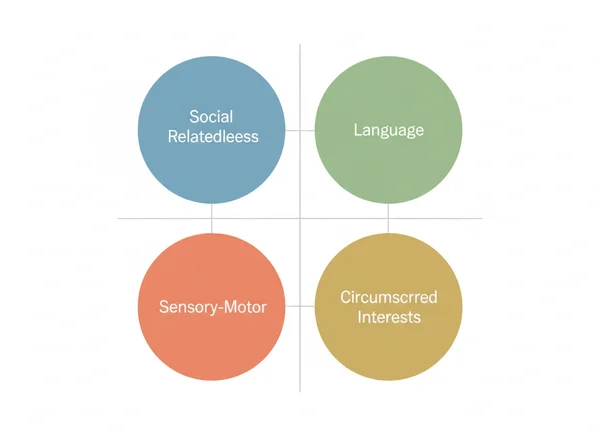
The Four Domains the RAADS-R Measures
The RAADS-R evaluates autistic traits across four distinct domains:
- Social Relatedness — how you connect with others, read social cues, and navigate relationships
- Language — your relationship with verbal and nonverbal communication, including pragmatic language use
- Sensory-Motor — sensitivity to sensory input like light, sound, texture, and physical coordination patterns
- Circumscribed Interests — intense focus on specific topics or activities, often to the exclusion of others
Each domain contributes a subscore to your total, giving you a more nuanced picture than a single number alone.
How the 80 Questions Are Structured
Every question on the RAADS-R asks you to choose from four response options:
- True now and when I was young (lifelong pattern)
- True only now (developed later)
- True only when I was younger than 16 (childhood only)
- Never true
This temporal structure is crucial. Because autism is a developmental condition, the test looks for patterns that have been present across your life — not just recent experiences. This design helps distinguish autistic traits from situational anxiety, depression, or other conditions that might mimic some surface-level similarities.
How Is the RAADS-R Scored and What Do Results Mean?
Understanding your RAADS-R score requires context. A number alone doesn't tell the whole story, and the hassan autism test conversation highlights exactly why interpretation matters.
RAADS-R Score Ranges at a Glance
| Score Range | General Indication |
|---|---|
| 25 or below | Few autistic traits identified |
| 26–64 | Some autistic traits present; may warrant further exploration |
| 65–129 | Significant autistic traits; consistent with autism likelihood |
| 130–227 | Strong indication of autistic traits across multiple domains |
The threshold score of 65 is often cited as the point above which autism is considered likely. However, this is a screening threshold — not a diagnostic cutoff.
What a High or Low Score Actually Suggests
A high RAADS-R score suggests that you experience a significant number of traits commonly associated with autism. It does not mean you are definitely autistic. Similarly, a low score does not rule out autism entirely.
Several factors can influence your score:
- Masking — if you've learned to hide or compensate for traits, you may score lower than expected
- Self-awareness — limited insight into your own patterns can skew responses
- Co-occurring conditions — ADHD, anxiety, or social anxiety can overlap with some autistic traits
- Cultural context — social norms vary, and some questions may land differently depending on your background
In short, treat your score as a conversation starter — not a conclusion.
Key Differences Between a Screening Tool and a Clinical Diagnosis
This section is essential. The hassan autism test trend has introduced many people to self-assessment tools, but it's important to understand where these tools fit in the bigger picture.
What a Screening Tool Can and Cannot Do
A screening tool like the RAADS-R can:
- Help you organize your thoughts and notice patterns
- Give you language to describe experiences you've always had
- Provide a starting point for conversations with professionals
- Offer a moment of self-reflection and validation
A screening tool cannot:
- Diagnose autism spectrum disorder
- Replace a clinical evaluation
- Account for the full complexity of your developmental history
- Provide therapeutic guidance
What a Formal Autism Assessment Looks Like
A professional autism diagnosis typically involves:
- A detailed developmental history interview
- Behavioral observation (often using tools like the ADOS-2)
- Evaluation of co-occurring conditions (ADHD, anxiety, depression)
- Input from family members or partners who know you well
- Assessment by a psychologist, psychiatrist, or specialist team
The process can take several sessions and may cost between a few hundred to several thousand dollars depending on your location and insurance.
When Should You Consider a Professional Evaluation?
Consider reaching out to a professional if:
- Your screening score is elevated and the results resonate with your lived experience
- You've noticed lifelong patterns in social communication, sensory sensitivity, or intense interests
- You want clarity to access support, accommodations, or simply better self-understanding
- Friends, family, or a therapist have suggested it might be worth exploring
This article is for educational purposes only. No online screening tool — including the ones Hassan took — can replace a formal evaluation by a qualified professional.
Why Online Autism Self-Assessment Tools Keep Going Viral
Hassan's stream wasn't an isolated event. Online autism tests have been trending across social media for years, and there are good reasons why.
The rise of the neurodiversity movement has shifted public understanding of autism from a deficit-based view to a more inclusive, strengths-based perspective. Platforms like TikTok and Reddit have created spaces where autistic adults share their experiences openly, helping others recognize similar patterns in their own lives.
For many late-identified adults, these online tools represent the first accessible entry point. Formal diagnosis can be expensive, time-consuming, and emotionally exhausting. A free, private screening tool offers a low-stakes way to begin exploring — without commitment or judgment.
The virality of moments like Hassan's test also reflects a deeper cultural shift. People are increasingly comfortable discussing mental health and neurodevelopmental differences in public. When a popular streamer takes a test and reacts honestly, it normalizes the entire process of self-exploration.
That said, it's worth being thoughtful about how you approach these tools. They work best when used as a starting point for reflection — not as a definitive answer.

How to Explore Your Own Traits with a Self-Reflection Tool
If Hassan's test sparked your curiosity, you might be wondering how to explore your own traits in a structured, thoughtful way. Here's how to approach it.
What You Can Learn from a RAADS-R-Inspired Assessment
A well-designed self-reflection tool can help you:
- Identify patterns you may not have consciously recognized
- Organize your experiences across social, sensory, language, and interest domains
- Build vocabulary for traits you've always felt but couldn't name
- Prepare for conversations with friends, family, or healthcare providers
The goal isn't to label yourself. Instead, it's about building a clearer picture of how you experience the world — and deciding what, if anything, you'd like to do with that information.
If you're curious, you can try a RAADS-R inspired assessment designed for self-reflection. It covers the same core domains as the test Hassan took, with results you can review privately at your own pace.
This tool is for educational purposes and self-reflection only. It is not a diagnostic instrument and does not replace professional evaluation.
What to Do After You Get Your Results
Once you've completed an assessment, here are some grounded next steps:
- Sit with your results — give yourself time to process without rushing to conclusions
- Journal your reflections — write down which questions resonated and which surprised you
- Share if it feels right — consider talking with a trusted friend or partner about what you noticed
- Research further — read about the specific domains where you scored highest
- Consult a professional — if your results resonate strongly, consider booking an assessment with a specialist
Remember: a screening result is the beginning of a conversation, not the end of one.
What Hassan's Test Moment Teaches About Self-Understanding
Hassan's decision to take an autism test on stream wasn't a medical event — it was a cultural one. And it carries some valuable takeaways for anyone curious about their own neurodevelopmental patterns.
Here's what you can take away:
- Curiosity is healthy — wanting to understand yourself better is a positive step, not a sign of something wrong
- Screening tools have real value — even without diagnostic power, they can spark meaningful self-reflection
- Context matters — a score is just a number until you place it alongside your lived experience
- Professional support exists — if you want deeper answers, qualified specialists can help
- You're not alone — millions of adults are exploring similar questions right now
Whether you watched Hassan's stream out of curiosity or because something in it felt familiar, the most important thing is to give yourself permission to explore at your own pace. And if you'd like a structured starting point, the RAADS-R inspired tool on our site is here whenever you're ready.
Frequently Asked Questions
How accurate is the RAADS-R as a screening tool?
The RAADS-R has a reported sensitivity of 97% and specificity of 100% in research settings. However, these numbers reflect controlled clinical conditions. In real-world self-administration — like the hassan autism test taken on stream — accuracy depends on honest, reflective responses and should always be followed up with professional evaluation.
How long does the RAADS-R take to complete?
Most people complete the RAADS-R in 10 to 30 minutes. Taking your time with each question tends to produce more accurate and personally meaningful results.
Is the RAADS-R free to take online?
Yes. Several websites offer the RAADS-R or RAADS-R-inspired assessments at no cost, including tools designed specifically for self-reflection rather than clinical use.
Can the RAADS-R be used for children?
The RAADS-R was originally designed for adults aged 16 and older. For younger children, other screening tools like the M-CHAT-R/F are more appropriate. Some adapted assessments allow parents to help younger users reflect on their traits with guidance.
What does the RAADS-R stand for?
RAADS-R stands for Ritvo Autism Asperger Diagnostic Scale–Revised. It was developed by Dr. Riva Ariella Ritvo at the Yale School of Medicine as a self-report tool designed to assist in identifying autism in adults.
Can a low RAADS-R score rule out autism?
No. A low score suggests fewer autistic traits were identified by the screening, but it cannot definitively rule out autism. Factors like masking, limited self-awareness, or co-occurring conditions such as ADHD may lead to lower scores even when autism is present. Only a comprehensive professional evaluation can provide clarity.