What Is the RAADS-R Test? Adult Autism Scores, Evidence, and Next Steps
Learn what the RAADS-R test measures, how adult scores work, what accuracy studies show, and how to prepare for a professional assessment conversation.
Want to see where you score?
Take the Free RAADS-R TestBy Elara Vance · Updated November 3, 2026
The RAADS-R test is an 80-item adult self-report questionnaire about social relatedness, language, sensory-motor experiences, and focused interests. Its full name is the Ritvo Autism Asperger Diagnostic Scale–Revised. Ritvo and colleagues developed it to assist clinicians assessing autism in adults, with a clinician present to clarify questions. An online score is information for reflection, not a clinical conclusion.
If you are wondering what is the RAADS-R test and whether it could help you, the useful distinction is between recording experiences and establishing their explanation. The questionnaire can organize the former; an assessment considers the latter. You can explore the adult RAADS-R questionnaire with that distinction in mind.
This guide is educational. A score cannot establish or exclude autism, replace professional assessment, or determine support needs. If you are in immediate danger or may harm yourself, contact local emergency services or a crisis service rather than waiting for a questionnaire result.
What the RAADS-R measures and who it is for
The original research describes a self-report measure for adults aged 18 and older with average or above-average intellectual ability. Its validation sample included adults with established diagnoses and comparison participants, including people receiving psychiatric care. That is different from a person completing an online questionnaire while wondering about autism for the first time. Ritvo et al. (2011) explicitly described clinician-assisted use rather than unsupervised online screening.
Adults seeking an explanation for longstanding communication or sensory experiences may find the questions useful conversation prompts. A partner or family member can contribute observations to an assessment, but should not substitute their answers for the adult's own experiences. For a child, seek age-appropriate professional guidance rather than applying adult scores.
The four areas below follow the original scale. Examples illustrate what to reflect on; they are not additional test questions or diagnostic criteria.
| Area | Items | Possible score | Reflection prompt |
|---|---|---|---|
| Social relatedness | 39 | 0–117 | What happens during social interaction, and what feels difficult to interpret? |
| Circumscribed interests | 14 | 0–42 | How do focused interests, routines, or changes feature in everyday life? |
| Language | 7 | 0–21 | When do literal and implied meanings cause misunderstandings? |
| Sensory-motor | 20 | 0–60 | Which sensory or movement experiences matter in daily activities? |
The maximum scores follow from the item counts and scoring. These areas organize answers; they are not separate diagnoses, ability ratings, or a validated map of clinical support needs. A fluent speaker can still have communication experiences worth discussing. Likewise, the social section should not be reduced to whether someone wants friends.
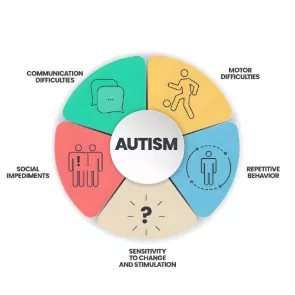
For more detail about the questionnaire's structure, see the guide to RAADS-R domains and subscales.
How the RAADS-R test works
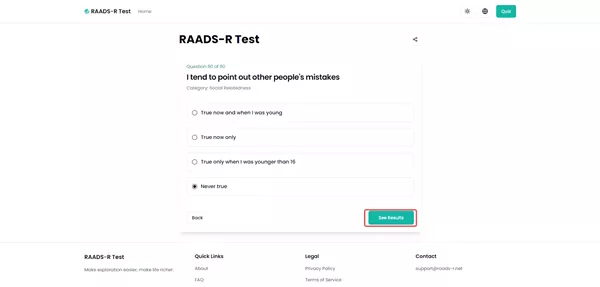
The RAADS-R uses a timeline rather than a simple agree-or-disagree format. For each statement, you choose whether it is true now and when you were young, only now, only before age 16, or never true. The timeline makes childhood examples relevant alongside current experiences.
For symptom-direction items, those options score 3, 2, 1, and 0 respectively. Reverse-scored items use 0, 1, 2, and 3. The site's implementation follows the 17 starred reverse-scored items in the original appendix. The total runs from 0 to 240. Because some items reverse direction, manually treating every stronger agreement as more points produces an incorrect total.
Before answering, choose a setting where you can read carefully. For a confusing item, note what was unclear and the example you had in mind. If you can perform a social task but find it effortful, record both the outward behavior and the effort for later discussion; do not invent a different response rule. If childhood memories are uncertain, keep that uncertainty in your notes instead of constructing a history to fit a score.
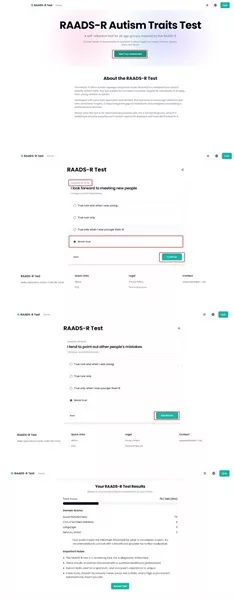
On this site, the questionnaire is on the homepage. Complete the statements, then review the total and the site's descriptive band. The free result provides a total; do not assume it includes separate subscale scores. Keep the answers or examples you want to discuss, rather than relying on a result label alone. There is no need to rush to meet a completion-time target.
What RAADS-R scores mean
The original clinician-assisted validation identified 65 as a study cut-off. Reaching that number is not equivalent to receiving a diagnosis. Falling below it does not rule out autism: the original autistic sample included people below the cut-off, and the authors said clinical judgment takes priority.
A total records your scored responses. It does not supply the probability that you are autistic, measure autism severity, or assign a clinical support level. Two people with the same total may have answered different items and may need quite different kinds of help.
The site's result bands are interface descriptions, not research-established severity categories:
| Site label | Total score |
|---|---|
| Minimal | 0–49 |
| Very low | 50–64 |
| Low | 65–89 |
| Moderate | 90–129 |
| High | 130–159 |
| Very high | 160–240 |
For example, 125 falls in the site's “Moderate” band and 150 in its “High” band. Both exceed the original study cut-off, but neither number establishes a diagnosis or the amount of support someone needs. A score of 160 enters the site's “Very high” band with the same limitation. These labels should not override difficulties that matter to you at a lower score.
Why different thresholds and percentile claims need context
A threshold is chosen and evaluated in a particular sample. Later studies have not all reproduced the original results. A threshold from another clinic or questionnaire version should not be imported into your result as a new universal rule. A percentile likewise needs a defined comparison population; a total of 150 out of 240 is not automatically a percentile or a percentage likelihood of autism.
For a more focused explanation, review the RAADS-R score range and interpretation guide. The practical question after a result is which experiences need explanation and support, rather than which label sounds most reassuring.
Is the RAADS-R test accurate and reliable?
The original study and later clinical research answer different questions. Ritvo et al. (2011) studied 779 participants: 201 autistic adults and 578 comparison participants. All completed the measure with clinical personnel present. The paper reported sensitivity of 97% and specificity of 100% in that sample. Those are study results, not the accuracy of this website or of anonymous online self-assessment.
Sensitivity concerns identification of autistic participants; specificity concerns classification of comparison participants. Neither statistic tells an individual reader the probability that a particular online score means autism. The population being assessed and the assessment setting matter.
The original study also reported a test–retest correlation of .987 in 30 participants reassessed after approximately a year. That concerns consistency of scores in that small research group. A consistent score and a correct diagnostic conclusion are different things.
What later research adds
Andersen et al. (2011) found lower sensitivity and specificity in a Swedish validation and emphasized clinical interviews in ambiguous cases. Conner et al. (2019) found that RAADS-R total scores did not significantly distinguish adults who ultimately received an autism diagnosis from those who did not in an outpatient assessment sample. Jones et al. (2021) reported no association between scores and diagnostic outcome in a specialist service.
A systematic review by Baghdadli, Russet, and Mottron (2017) found limitations in the evidence for adult screening and diagnostic tools, including bias and applicability concerns. It supported combining self-report information with clinical expertise. The balanced reading is that the RAADS-R offers structured information, while its usefulness for predicting diagnosis varies by setting.
Why an online result can be difficult to interpret
An online questionnaire cannot clarify every interpretation or examine developmental history. NIMH explains that adult autism assessment can be complicated by overlap with conditions such as anxiety and ADHD. An elevated response pattern therefore needs interpretation rather than an automatic explanation.
If you camouflage difficulties, write down what you do to manage an interaction and how it feels. That gives an assessor something concrete to explore. It does not justify adding points, adjusting a cut-off, or assuming a masking-specific accuracy rate. Repeating questionnaires until the results agree also cannot resolve the clinical question by itself.
RAADS-R versus other autism assessment tools
A longer questionnaire is not automatically a better answer to every question. The tools have different roles, and their scores are not interchangeable.
| Tool or approach | Role supported by the cited guidance or research | What to keep distinct |
|---|---|---|
| RAADS-R | Adult self-report information used with clinical expertise | An online total does not reproduce clinician-assisted validation |
| RAADS-14 Screen | A shorter adult screening instrument derived from RAADS-R items | Its 14 items, scoring range, and screening threshold differ |
| AQ-10 | A brief tool NICE considers in adult identification | Referral also depends on clinical judgment |
| AAA, ADI-R, and ADOS-based approaches | Tools considered within professional assessment | They are not substitutes for the whole clinical assessment |
NICE lists the RAADS-R among tools that may help with more complex adult assessment. Its adult identification guidance considers the AQ-10 and clinical judgment when deciding about comprehensive assessment. This does not make any online questionnaire a standalone diagnostic pathway.
If you already have a RAADS-R result, ask what additional information would answer the unresolved question. Another score may be less useful than developmental records, examples from daily life, or a discussion of overlapping difficulties. The comparison of RAADS-R and other autism assessments explains these roles further.
Turn your result into an assessment conversation
A useful next step is a short record of experiences, not an argument built around a threshold. NIMH describes adult evaluation as considering communication, social interaction, sensory experiences, repetitive behavior, interests, and early development. NICE recommends involving an informant or records where possible.

Try a simple example log: situation → what happened → childhood or current pattern → effect on daily life → question for the clinician. For instance, you might describe misunderstanding an indirect instruction, what clarification helped, and whether similar situations occurred at school. This is a preparation exercise, not a clinical scoring system.
A later diagnosis does not mean an experience began in adulthood. When preparing your history, clearly separate when you first noticed a pattern from when it first occurred. NICE recommends looking at early development where possible. If someone remembers things differently, bring that difference to the assessment instead of trying to make every account agree before asking for help.
The following decision table helps separate the result from the decision it can inform:
| Your situation | Useful next step | Information to bring |
|---|---|---|
| Elevated score and longstanding difficulties | Ask a healthcare professional about an adult autism evaluation | Result, examples, developmental history, and current concerns |
| Lower score but persistent concerns | Discuss the concerns without treating the score as an exclusion | Experiences the questionnaire did not capture or that were unclear |
| Uncertain answers or limited childhood memory | Record the uncertainty and ask how it can be explored | Available school records or an informant, where possible |
| Main concern is support at work or home | Describe the specific problem and ask about suitable support | What is difficult, what you have tried, and what helped |
Questions to bring include: What does this score add? What does it leave unanswered? How will you explore ADHD or anxiety alongside autism? What information would be useful if childhood records are unavailable? What support can we discuss while assessment is pending?
A questionnaire result alone does not establish eligibility for accommodations or services. Ask the relevant provider what evidence is needed. If you want help preparing the conversation, use the guide to discussing RAADS-R results with your doctor.
References
Ritvo RA, et al. (2011). The Ritvo Autism Asperger Diagnostic Scale-Revised (RAADS-R): A Scale to Assist the Diagnosis of Autism Spectrum Disorder in Adults: An International Validation Study. Journal of Autism and Developmental Disorders. doi: 10.1007/s10803-010-1133-5.
Andersen LMJ, et al. (2011). The Swedish Version of the Ritvo Autism and Asperger Diagnostic Scale: Revised (RAADS-R). A Validation Study of a Rating Scale for Adults. Journal of Autism and Developmental Disorders. doi: 10.1007/s10803-011-1191-3.
Baghdadli A, Russet F, Mottron L. (2017). Measurement properties of screening and diagnostic tools for autism spectrum adults of mean normal intelligence: A systematic review. European Psychiatry. doi: 10.1016/j.eurpsy.2017.04.009.
Conner CM, Cramer RD, McGonigle JJ. (2019). Examining the Diagnostic Validity of Autism Measures Among Adults in an Outpatient Clinic Sample. Autism in Adulthood. doi: 10.1089/aut.2018.0023.
Jones SL, et al. (2021). The Effectiveness of RAADS-R as a Screening Tool for Adult ASD Populations. Autism Research and Treatment. doi: 10.1155/2021/9974791.
Eriksson JM, Andersen LMJ, Bejerot S. (2013). RAADS-14 Screen: validity of a screening tool for autism spectrum disorder in an adult psychiatric population. Molecular Autism. doi: 10.1186/2040-2392-4-49.
National Institute for Health and Care Excellence. Autism spectrum disorder in adults: diagnosis and management, CG142, Recommendations; AQ-10 recommendation amended 2021. NICE.
National Institute of Mental Health. (2025). Autism Spectrum Disorder. National Institutes of Health.
Choose a next step based on your questions
What is the RAADS-R test most useful for? Organizing self-reported experiences that you can examine alongside your history and daily needs. You do not have to make the number explain everything. Keep the result, note uncertainties, and choose whether your next priority is information, professional assessment, or a conversation about a specific difficulty.
The next steps after a RAADS-R result can help you prepare. The aim is a clearer conversation and a useful next action, with or without a settled diagnostic answer today.
Frequently Asked Questions
What is a good RAADS-r score?
There is no score to aim for. The total describes scored responses, not success, health, or personal worth. The original study cut-off of 65 is not a diagnostic boundary for online users. Consider the experiences behind your answers and any support you need.
Is the RAADS-R test reliable?
The original study reported strong test–retest consistency in a small retested group, but later clinical studies found limitations in predicting diagnosis. Reliability does not mean an online score can determine whether you are autistic. Interpretation requires history and clinical context.
Is a RAADS-R score of 150 considered high?
On this site, 150 is in the “High” descriptive band. That band is site-defined, not a validated severity category. It exceeds the original study cut-off but does not establish autism, a percentile, or a clinical support level.
What does a RAADS-R score of 125 mean?
It falls in this site's “Moderate” descriptive band and exceeds the original study cut-off. It records your scored answers, without establishing their cause. Bring relevant examples and uncertainties to a professional conversation if you want an evaluation.
Ready to explore your answers? Take the free test and see your score.
Take the Free RAADS-R Test