Online Autism Diagnosis: What Online Tests Can and Cannot Tell You
Want to see where you score?
Take the Free RAADS-R TestSearching for online autism diagnosis can feel hopeful, confusing, and a little vulnerable. You may want privacy, speed, lower cost, or a clearer way to name experiences that have been hard to explain. Online screeners can support that first step, especially when they are framed as self-reflection rather than a final answer. A tool such as the RAADS-R self-reflection tools can help you organize patterns around social communication, sensory differences, language, routines, and long-term masking. Still, an online result is not the same as a formal clinical evaluation. The most useful approach is to understand what online tools can reveal, what they cannot decide, and how to use the results in a grounded next-step plan.

What People Usually Mean by Online Autism Diagnosis
Most people who type "autism diagnosis online" are not asking for only one thing. Some want a quick autism diagnosis test online free because they are unsure whether their experiences fit autism. Some are adults who have masked for years and are looking for online adult autism diagnosis information before speaking with a clinician. Others are parents trying to understand whether an ASD test, M-CHAT-R, or developmental checklist should lead to a pediatric evaluation.
That mixed intent matters. Online tools can include self-report questionnaires, caregiver screeners, telehealth intake forms, clinician-led remote assessments, and educational quizzes. They do not all carry the same weight. A free online screener may help you notice traits. A clinician-led telehealth appointment may be part of a formal assessment process. A casual quiz may be interesting but limited. The phrase online autism diagnosis is useful as a search term, but the real question is: what kind of online process are you using, who interprets it, and what decision will be made from it?
What Online Autism Tests Can Actually Do
Online autism tests are strongest when they help you notice patterns. A well-designed screener can ask about social energy, literal communication, sensory sensitivity, repetitive routines, intense interests, transitions, masking, and burnout. It may also help you compare experiences across time, such as traits that were present in childhood but became harder to spot in adulthood because you learned to compensate.
For adults, tools related to the RAADS-R Scale, AQ, CAT-Q, and autistic burnout can be useful because they separate different parts of the experience. RAADS-R style questions look across several domains of autistic traits. CAT-Q focuses on camouflaging and masking. An ASD test or aspie quiz may help a person find language for experiences, although quiz quality varies widely.
The key is to treat the score as a conversation starter. If you use the free RAADS-R screening experience, consider saving a short note about which answers felt obvious, which felt hard to interpret, and which examples from daily life came to mind. That record may be more useful than the number alone when you later discuss concerns with a qualified professional.

What an Official Autism Assessment Usually Requires
An official autism diagnosis generally depends on a broader evaluation, not one online score. A professional may review developmental history, current behaviors, communication patterns, sensory experiences, school or work history, mental health context, and observations from the person or people who know them well. For children, caregivers and pediatric records often matter. For adults, childhood memories, family input, past reports, and examples of masking may help build a fuller picture.
Some providers offer online or hybrid assessments. That can be legitimate when a qualified clinician follows appropriate standards and gathers enough information. However, a self-guided quiz by itself is different from a professional assessment. The safer question is not "Can the internet decide this for me?" but "Is this online process run by qualified people, and does it include enough evidence for a careful evaluation?"
This distinction is especially important for people also exploring ADHD, anxiety, trauma, OCD, learning differences, or depression. Many experiences can overlap. A careful assessment looks at the full context rather than treating one screening result as the whole story.
Signs That May Lead Someone to Seek Evaluation
Many people begin with online screening because certain patterns have followed them for years. These signs do not prove autism, but they can explain why further evaluation feels worth exploring.
Social communication patterns
You may feel that conversation requires active translation. Small talk can be draining, indirect hints may be confusing, facial expressions may take effort to read, or you may rehearse conversations before and after they happen. Some people are highly verbal but still find real-time social timing exhausting.
Sensory and routine patterns
Sensory differences may include strong reactions to sound, light, textures, food, crowded rooms, or sudden changes. Routines and predictability can feel stabilizing. Changes may be manageable on the outside while creating intense internal stress.
Masking, burnout, and adult discovery
Many adults reach this topic after years of appearing "fine" while privately feeling depleted. Masking can mean copying social scripts, suppressing stims, forcing eye contact, or hiding sensory needs. Over time, that effort can contribute to burnout, shutdowns, or a sense that ordinary life takes more energy than other people seem to spend.
Comparing RAADS-R, ASD Tests, CAT-Q, and Aspie-Style Quizzes
Not all online tools answer the same question. A broad ASD test may screen for general autistic traits. RAADS-R based tools focus more deeply on traits often discussed in adult autism self-assessment. The CAT-Q is different because it looks at camouflaging rather than autism traits alone. Aspie-style quizzes may feel personally resonant for some users, but they should be interpreted cautiously unless their basis and scoring are clear.
Use this simple comparison when choosing a tool:
- If you want a structured adult trait screen, RAADS-R may be a reasonable starting point.
- If you suspect masking is hiding your traits, CAT-Q can add useful context.
- If you are looking at a toddler or young child, age-specific screeners such as M-CHAT-R are more relevant than adult tools.
- If a quiz gives dramatic certainty or pushes a single answer, treat it with caution.
- If results affect school, work, insurance, services, or accommodations, bring them to a qualified professional rather than relying on the quiz alone.
The best online autism diagnosis research path often uses more than one kind of information: a reputable screener, real-life examples, developmental history, and professional guidance when needed.
How to Use Online Results Without Over-Reading Them
After taking an online autism test, pause before making big conclusions. Scores can be influenced by stress, question wording, masking, culture, language, co-occurring conditions, and how literally you read the questions. A high score may suggest that further exploration is worthwhile. A lower score does not automatically erase your concerns, especially if you are highly masked or the tool was not designed for your age group.
Try this practical note format:
- Write down the tool name, date, and result.
- List three answers that strongly matched your life.
- List three questions that felt unclear or too narrow.
- Add examples from childhood, school, work, relationships, and sensory environments.
- Note any current pressures, such as burnout, anxiety, sleep loss, or major life change.
- Decide whether your next step is more education, another self-screen, or a professional conversation.
This turns online screening from a single score into organized self-knowledge. It also lowers the chance of chasing certainty from tool to tool.
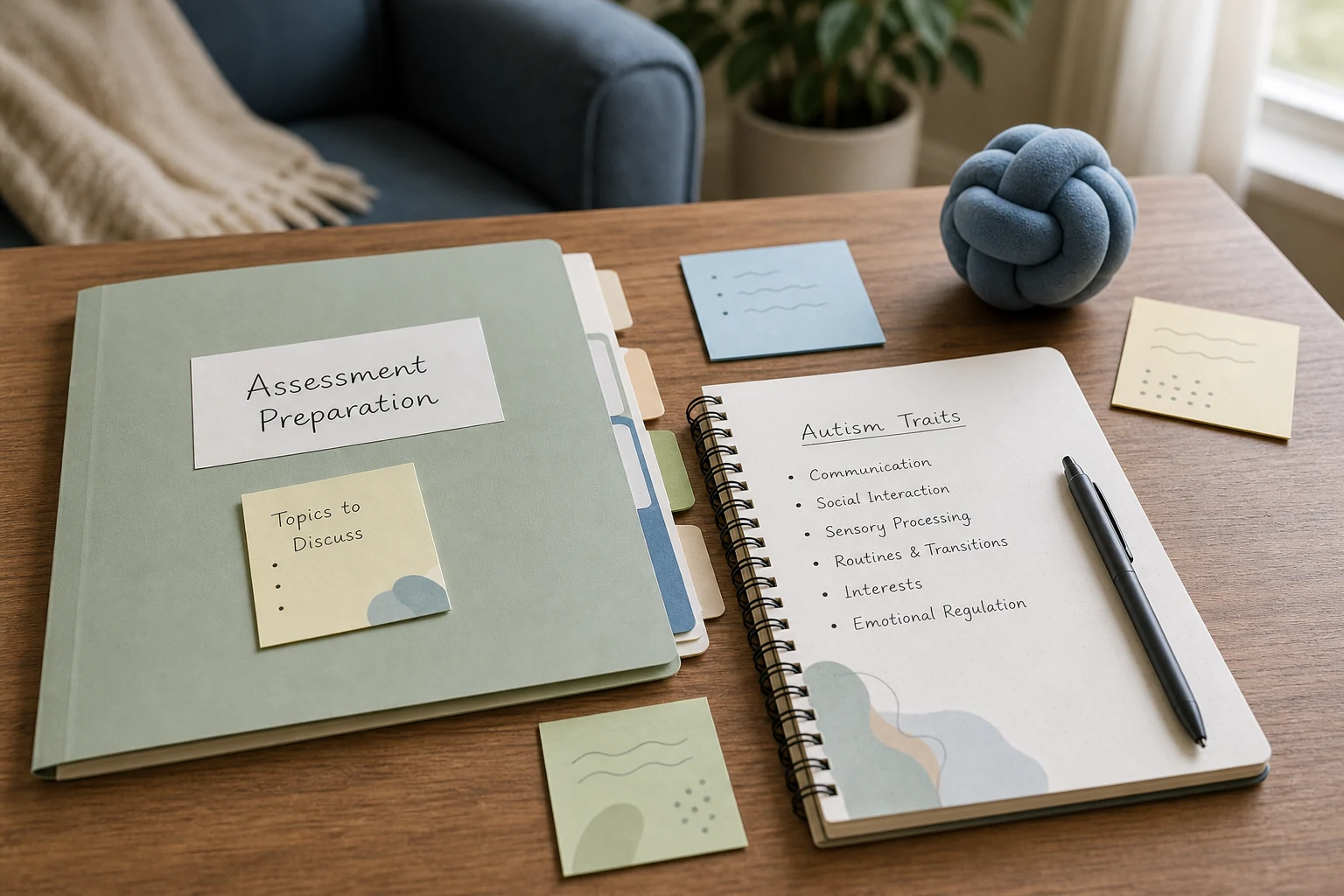
When Online Autism Diagnosis Searches Should Lead to Professional Support
Consider professional support if the question is affecting your daily life, relationships, school, work, mental health, or access to services. You may also want support if you are exploring both autism and ADHD, if you have a history of trauma, if a child is missing developmental milestones, or if you need documentation for accommodations.
You do not need to have perfect language before reaching out. Online tools can help you prepare, but you can also say, "I have noticed long-term patterns in social communication, sensory processing, routines, or masking, and I would like guidance." If you are not ready for an appointment, educational self-reflection through supportive autism self-assessment resources can still help you organize what you know.
The most balanced view is this: online autism diagnosis searches can open the door, but careful evaluation, support planning, and personal meaning-making usually require more than one score. Let online tools help you gather clues, not pressure you into certainty.
FAQ
Can you receive an official autism diagnosis online?
Sometimes a qualified clinician may use telehealth as part of an official assessment, depending on location, age, service rules, and the type of evaluation required. A self-guided online quiz alone is not the same thing. If you need documentation for services, school, work, insurance, or clinical care, check the provider's credentials and ask what their assessment includes.
Are any online autism tests accurate?
Some online screeners are more useful than others, especially when they are based on established questionnaires and explain their limits. Accuracy still depends on the person, age group, context, and purpose. Online tests are best for screening and self-reflection, not final certainty.
What are signs of lower-support-needs autism in adults?
Common patterns can include social exhaustion, literal communication, sensory sensitivity, strong need for routine, intense interests, difficulty with transitions, and long-term masking. The phrase "high functioning" is still searched often, but many people prefer language that separates visible independence from real support needs.
What is the 6 second rule for autism?
There is no universal clinical "6 second rule" that decides autism. In everyday support discussions, people may use short pauses to give someone more processing time before repeating a question or adding pressure. If a pause helps communication feel calmer, it can be a useful accommodation, but it is not an autism test.
Is an online autism diagnosis free?
Free online tools usually offer screening or self-reflection, not a full formal assessment. Professional evaluations may cost money, though coverage and public options vary by country, state, insurance plan, or health system. Be cautious with any site that promises a free official answer without a careful process.
Should I take RAADS-R, CAT-Q, or an ASD test first?
For many adults, RAADS-R can be a structured starting point for autistic traits, while CAT-Q can help explore masking. A general ASD test may be broader but less detailed. If you are choosing for a child, use an age-appropriate screener and speak with a pediatric professional about concerns.
What should I do after a high online autism test score?
Write down the result, the tool name, examples that matched your life, and questions that felt unclear. Then decide whether you want more education, another reputable screener, peer support, or a conversation with a qualified professional. Treat the score as information, not a verdict.
Ready to explore your answers? Take the free test and see your score.
Take the Free RAADS-R Test