Discussing Your RAADS-R Test Results With Your Doctor: A Comprehensive Autism Guide
Taking an online RAADS-R test is a significant first step toward self-understanding. It can provide a framework for experiences you may have felt for years but couldn't quite name. But once you have your results, a new question often arises: What comes next?
Many adults who receive a high score on this screening feel a mix of relief and anxiety. The idea of discussing these results with a doctor can be daunting. You might worry about being dismissed, misunderstood, or unsure how to even start the conversation. This guide is here to help. We will walk you through how to prepare for and have a productive conversation about your RAADS-R results with your healthcare provider.
Your self-discovery journey is deeply personal, and the right tools can make all the difference. If you're just starting to explore your traits, our free and confidential RAADS-R inspired test is an excellent starting point. This article will help you use those results to take the next, crucial step.

Preparing for Your Medical Consultation
Walking into a doctor's office with a printout from an online test can feel intimidating. However, with the right preparation, you can turn this into a structured, effective conversation. Proper preparation shows your doctor that you've thought deeply about your experiences and are seeking professional guidance, not just a quick label.
Organizing Your RAADS-R Results and Documentation
Your RAADS-R score is more than just a number; it’s a summary of your self-reported traits across different areas. Before your appointment, organize this information clearly.
- Print Your Results: Bring a copy of your total score and the breakdown of your sub-scores (Social Relatedness, Language, Sensory/Motor, and Circumscribed Interests).
- Highlight Key Areas: Note the areas where you scored highest. These are the specific domains where your traits are most pronounced and are a great starting point for discussion.
- Use the AI Report (If Applicable): If you completed the optional AI-powered analysis on our site, bring that report too. This personalized analysis from RAADS-R Net connects your scores to your life context, providing richer detail that can be very helpful for a clinician.
Having this documentation ready makes it easier for your doctor to quickly understand the basis of your concerns.
Creating a Timeline of Your Experiences and Challenges
A screening tool provides a snapshot, but your life experiences provide the full picture. Doctors need to understand the pattern of your challenges over time, not just your current feelings. Create a timeline that includes examples from different life stages.
- Childhood (before age 16): Did you struggle to make friends? Were you intensely focused on specific hobbies? Did teachers comment on your social behavior or communication style?
- Adolescence: How did you navigate high school social dynamics? Did you feel different from your peers? Did sensory issues (like loud cafeterias or bright lights) become more challenging?
- Adulthood: What challenges do you face at work, in relationships, or in daily life? Think about misunderstandings in communication, sensory overload, difficulty with executive functioning, or social burnout. You can also discover strategies for autism workplace accommodations.
Jotting these points down ensures you won't forget important details during your appointment.
Gathering Additional Information About Your Family History
Some neurodevelopmental traits can have a genetic component. While not always the case, information about your family can be a useful piece of the puzzle for your doctor.
Think about your parents, siblings, aunts, uncles, or cousins. Has anyone been formally diagnosed with autism or another neurodevelopmental condition like ADHD? Even without a diagnosis, have family members been described as "quirky," "eccentric," "shy," or having unique and intense interests?
Mentioning this doesn't confirm anything, but it provides additional context that a thorough clinician will find valuable. It shows you're considering all angles as part of your preparation.
Effectively Communicating Your Concerns to Healthcare Providers
Once you're prepared, the next step is the conversation itself. The way you frame your concerns can significantly impact how they are received. The goal is to open a collaborative dialogue with your doctor, presenting yourself as an informed partner in your own healthcare.
Framing Your RAADS-R Results for Medical Professionals
This is one of the most critical parts of the conversation. It is essential to remember and state that the RAADS-R is a screening tool, not a diagnostic one. Presenting your results as definitive proof of autism can sometimes put healthcare providers on the defensive.
Instead, frame your results as a guide that helped you organize your thoughts. You can say something like:
- "I took this online screening test, and the results suggested I have many traits associated with autism. It helped me understand some lifelong challenges, and I'd like to explore this further with a professional."
- "This tool has given me the language to describe experiences I've had with social communication and sensory issues. I'm here to get your professional opinion on what the next steps might be."
This approach positions the test as a starting point for a professional evaluation, which is exactly what it's designed for.

Using Specific Examples to Illustrate Your Daily Challenges
General statements like "I'm bad at socializing" are less helpful to a doctor than concrete examples. Connect your RAADS-R sub-scores to real-life situations.
- Instead of: "I have sensory issues."
- Try: "I find fluorescent lights in the office physically painful, and I often have to wear headphones in the grocery store because the noise is overwhelming."
- Instead of: "I have trouble with language."
- Try: "I often miss sarcasm and take things too literally, which has caused misunderstandings with my colleagues. I also find small talk confusing and exhausting."
- Instead of: "I have narrow interests."
- Try: "I can spend hours researching the history of urban planning, and I find it difficult to switch my focus when others want to talk about different topics."
These specific, real-world examples are the data a clinician needs to understand how your traits impact your functioning.
Sample Scripts for Discussing Your Results with Different Healthcare Providers
How you start the conversation can depend on your relationship with the provider. Here are a few sample openers:
- For your long-term General Practitioner (GP): "We've known each other for a while, and I want to discuss something personal. I've been struggling with social anxiety and burnout for years. Recently, I came across information on adult autism and took a screening called the RAADS-R. My score was high, and it resonated deeply. Could you refer me to a specialist for a formal assessment?"
- For a new doctor or a mental health therapist: "I'm seeking help for what I've always thought was anxiety and depression. However, after doing some research, I suspect my challenges might be rooted in undiagnosed autism. I took the RAADS-R screening and brought the results. I'm hoping we can explore this possibility together."
These scripts are respectful, clear, and focused on seeking professional guidance, setting a positive tone for the appointment.
Understanding the Professional Evaluation Process
Discussing your screening results is the first step. If your doctor agrees that further investigation is needed, they will likely refer you for a formal professional evaluation. Understanding this process can help reduce anxiety about what lies ahead.
From Screening to Assessment: What Happens Next
A screening tool like the RAADS-R identifies potential traits. A formal assessment, on the other hand, is a comprehensive process conducted by a qualified professional (like a psychologist or psychiatrist) to determine if you meet the clinical criteria for Autism Spectrum Disorder (ASD).
This is a positive next step. It means your concerns have been heard and are being taken seriously. The goal is to gain a complete understanding of your unique strengths and challenges. Learn more about interpreting your RAADS-R scores to better prepare. This understanding is key to finding the right support.
Types of Professional Autism Assessments
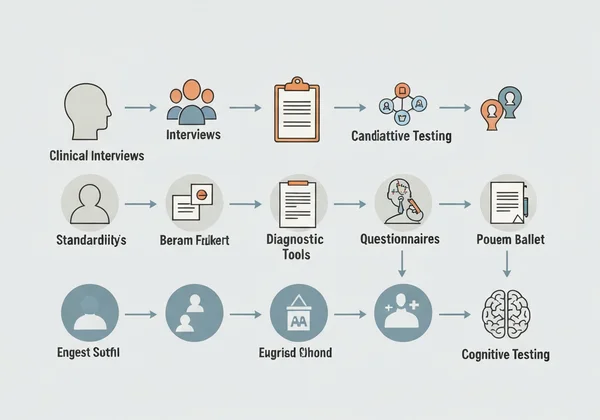
A formal autism assessment is not a single test. It's a multi-faceted evaluation that may include several components:
- Clinical Interviews: You'll have detailed conversations with the clinician about your developmental history, social communication style, interests, and daily struggles.
- Standardized Diagnostic Tools: The clinician may use specific tools like the ADOS-2 (Autism Diagnostic Observation Schedule) or the ADI-R (Autism Diagnostic Interview-Revised). These involve structured activities and questions.
- Questionnaires: You might be asked to fill out more detailed questionnaires. Sometimes, the clinician may also ask a parent or partner to provide their observations.
- Cognitive Testing: This is sometimes included to assess your profile of cognitive strengths and weaknesses.
The process can take several hours, often spread across multiple appointments.
Questions to Ask Your Healthcare Provider About Next Steps
To be an active participant in your healthcare, it's important to ask questions. If your doctor recommends a referral, consider asking the following:
- "Can you refer me to a specialist who has experience with diagnosing autism in adults?" (This is important, as adult diagnosis can be different from child diagnosis).
- "What is the typical wait time for an assessment in this area?"
- "Is there anything I can do to prepare for the formal assessment?"
- "Are there any local support groups or resources you would recommend in the meantime?"
These questions show that you are proactive and committed to understanding your path forward.
What to Do If Your Doctor Is Dismissive
It can be disheartening if your doctor dismisses your concerns or the results of your screening. Unfortunately, not all healthcare professionals are well-versed in adult autism, especially in how it presents differently from childhood autism. If this happens, remember that it is not a reflection on you or the validity of your experiences.
Calmly ask for their reasoning. If they are unwilling to discuss it further or provide a referral, it is your right to seek a second opinion. Look for a different doctor or a mental health professional who specifically lists "adult autism assessment" or "neurodiversity" as a specialty. Your health journey is your own, and finding a supportive professional is a crucial part of it.
Moving Forward: From RAADS-R Results to Professional Insights
Taking the RAADS-R test shows real courage and self-awareness. It marks the beginning of a journey toward understanding yourself more deeply. While the path from a screening result to a professional discussion can seem intimidating, preparation is your greatest asset.
Organize your results, document your life experiences, and frame the conversation collaboratively. These steps will empower you to have a productive dialogue with your doctor. Remember, the goal is not to prove you are autistic but to seek clarity and open the door to professional guidance. Your RAADS-R results are a valuable tool to help you start that important conversation.

If you are ready to take the first step or want to review your traits before an appointment, start your assessment on our platform today. Your journey to clarity begins with a single, informed step.
Frequently Asked Questions
Can I show my RAADS-R results to my doctor as proof of autism?
No, the RAADS-R is a screening tool, not a diagnostic instrument. You should present your results as evidence that has led you to seek a professional opinion, not as proof of a diagnosis. Frame it as the starting point for a conversation.
What if my doctor dismisses my RAADS-R results?
This can be disheartening, but don't give up. Calmly ask what their concerns are. If they are unwilling to discuss it further or refer you, you have the right to seek a second opinion from another doctor. Look for healthcare providers who specifically mention experience with adult autism.
Should I bring my AI personalized analysis report to my appointment?
Absolutely. The AI personalized report from the RAADS-R Net test provides valuable context that connects your scores to your personal history and challenges. This can give your doctor a much richer, more nuanced understanding of your situation than a simple score breakdown.
How can I find a doctor who understands adult autism assessment?
You can start by searching online for psychologists or psychiatrists in your area who specialize in "adult autism" or "neurodiversity." Autism advocacy websites and local support groups often have lists of recommended professionals. Your GP may also be able to find a suitable specialist through their referral network if you specifically request someone with experience in this area.