Autism Burnout Symptoms: A Guide to Recovery
If you wake up every morning with severe chronic exhaustion, everyday tasks can begin to feel entirely impossible.
Want to see where you score?
Take the Free RAADS-R TestIf you wake up every morning with severe chronic exhaustion, everyday tasks can begin to feel entirely impossible. For many neurodivergent individuals, navigating this profound state of depletion impacts every single area of daily life. This comprehensive guide breaks down the critical signs of this condition, maps out how it differs from depression, and delivers actionable, sensory-first strategies to help you safely rebuild your energetic baseline. You can check your traits with this comprehensive autism screening guide to start understanding your sensory needs. Our goal is to provide you with clear steps, useful checklists, and distinct recovery phases for deep self-understanding.
What Does Autistic Burnout Feel Like?
Autistic burnout is a state of profound mental, emotional, and physical depletion caused by the continuous strain of navigating a world not built for neurodivergent minds. It is fundamentally different from typical occupational burnout because it does not just stem from job stress. Instead, it arises from the cumulative cost of managing daily existence, social expectations, and sensory environments.
Why is Neurodivergent Burnout Different from Everyday Work Fatigue?
Everyday work fatigue usually improves after a weekend of rest or a short vacation. In contrast, neurodivergent burnout leaves you feeling completely empty, even after days of sleeping. The fatigue is systemic, making simple choices like what to eat feel utterly paralyzing. Also, it changes how your brain processes information and significantly lowers your ability to tolerate unexpected changes. When you are in this state, standard stress management techniques often fail because your threshold for neurological input has completely collapsed.
What are the Physical Warning Signs of Chronic Nervous System Overload?
When your nervous system stays in a state of chronic fight-for-flight, your body begins to reflect this internal chaos. Many individuals experience distinct autism burnout symptoms physical in nature, including chronic headaches, unexplained muscle tension, and severe digestive issues. Your sleep patterns may disrupt completely, leaving you feeling exhausted regardless of how many hours you spend in bed. Therefore, this physical collapse is your body's clear signal that it can no longer compensate for ongoing neurological stress. For example, you might experience unexplained muscle tremors or sudden localized pain as your body attempts to process the baseline tension.
The 5 Core Signs on the Autism Burnout Symptoms Checklist
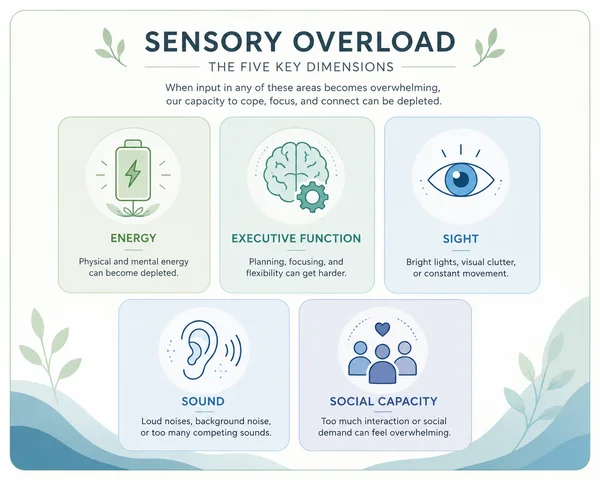
Identifying this profound state requires looking at your life through a structured framework. This section serves as an operational autism burnout symptoms checklist to help you clarify your current experience.
| Life Dimension | Core Symptom Expression | Real-World Impact |
|---|---|---|
| Energy Baseline | Pervasive Mental and Chronic Physical Exhaustion | Paralyzing fatigue that does not improve with standard rest. |
| Functional Ability | Acute Loss of Daily Living Skills (Skill Regression) | Sudden difficulty performing tasks like cooking or speaking. |
| Sensory System | Drastically Decreased Sensory Tolerance Profiles | Mild sounds, lights, or textures become physically painful. |
| Social Capacity | Social Pulling-Back and Communication Interruption | Complete inability to reply to texts or maintain conversations. |
| Acute Regulation | Frequent and Uncontrollable Meltdowns or Shutdowns | Frequent neurological crashes from minimal external friction. |
Sign 1: Pervasive Mental and Chronic Physical Exhaustion
This exhaustion feels like running a marathon on an empty battery. You might find yourself staring at a wall for hours, unable to muster the energy to move. Standard self-care routines fail to make a difference because your nervous system is deeply overtaxed. Meanwhile, even processing simple auditory sentences from family members can feel intensely draining.
Sign 2: How Does Skill Regression Affect an Autism Burnout Symptoms Adult?
Also known as skill regression, this sign can be deeply frightening for an autism burnout symptoms adult. You might suddenly struggle to organize a simple grocery list, remember basic words, or manage executive functioning tasks that you previously mastered. For instance, a professional who routinely creates complex data sheets might find themselves unable to compute basic household expenses. This is a temporary preservation tactic used by your brain, not a permanent loss of intelligence.
Sign 3: Drastically Decreased Sensory Tolerance Profiles
During burnout, your sensory filters break down completely. Fluorescent lights might feel like needles in your eyes, and background grocery store music can become an unbearable wall of noise. Because you lose the ability to tune out background stimuli, immediate cognitive overload occurs. Consequently, textures in food or clothing that used to be minor annoyances suddenly become completely intolerable.
Sign 4: Social Pulling-Back and Communication Interruption
You may find yourself completely ghosting friends, leaving emails unread, or struggling to speak at all. Socializing requires an immense amount of energy that you simply do not possess. If someone sends a friendly text, the mere thought of formulating a reply can induce severe panic. Pulling back is a necessary survival mechanism to protect your remaining energy reserves.
Sign 5: What Do Autistic Shutdowns and Meltdowns Feel Like?
When triggers accumulate, you might experience frequent meltdowns or shutdowns. A meltdown is an explosive release of neurological pressure, often resulting in crying or intense distress. In contrast, a shutdown is an internal system collapse where your brain turns completely inward. This state often causes temporary mutism, severe lethargy, and a total inability to process your surroundings. During a shutdown, you are completely conscious but frozen, watching the world pass by without the ability to interact.
How to Distinguish Autistic Burnout from Depression
Because both conditions involve intense exhaustion and social isolation, clinicians frequently misdiagnose burnout as clinical depression. However, treating burnout as depression can often make the condition worse if the underlying sensory triggers are ignored.
The Motivation vs. Energetic Capacity Distinction
The core difference lies in the relationship between your desire and your physical ability. Depression generally causes anhedonia, which means you lose interest in your favorite hobbies and special interests. In contrast, an autistic person in burnout still desperately wants to engage with their special interests but lacks the actual physical and cognitive capacity to do so. The motivation remains intact, but the biological engine is entirely out of fuel. If you give a depressed person a safe space to pursue their passion, they still feel empty; if you give a burned-out autistic person that space, they feel a deep longing mixed with intense physical paralysis.
How Sensory Sensitivity Rules Out Standard Clinical Depression Profiles
While depression can cause physical lethargy, it rarely increases your acute sensory sensitivity. If your exhaustion is accompanied by an intense intolerance to textures, sounds, and lights, you are likely looking at autism burnout symptoms. Understanding this distinction allows you to stop forcing yourself into standard depression treatments, like behavioral activation, which can cause further sensory overload. You can explore our educational resources online to gain more clarity on how these distinct neurological frameworks operate.
The AuDHD Intersection: When ADHD and Autism Burnout Collide
Living with co-occurring ADHD and Autism (often called AuDHD) creates a highly specific type of neurological exhaustion. This intersection changes how burnout develops and how it shows up in your daily life.
The Internal Push-Pull of Co-occurring Neurodivergent Traits
The AuDHD experience is an ongoing internal conflict. Your ADHD side constantly craves novelty, dopamine, and new projects, while your autistic side requires strict routine, predictability, and low sensory input. When you hit a wall, these two forces clash violently. You might find yourself deeply bored and craving stimulation, yet simultaneously too exhausted to move or process data. This friction creates a painful cycle of stagnation, where your brain feels both hyperactive and completely paralyzed.
Why Do Autism Burnout Symptoms Women Often Stem from Heavy Masking?
Many individuals, particularly autism burnout symptoms women, survive in a neurotypical world by using heavy social masking. Masking is the conscious mimicking of neurotypical social behaviors to fit in. This process relies heavily on a cognitive style called monotropism, where your brain channels all its processing power into a single tunnel of focus. When you spend all day in a masking tunnel, you ignore your body's hunger, pain, and sensory boundaries. Eventually, this intense, unsustainable focus leads to a massive, sudden neurological crash.
The Sensory Off-Grid Protocol: Your Path to Recovery
True recovery from this deep state of depletion requires more than just standard advice like taking a bubble bath or drinking water. You need a structured, non-medicalized manual to systematically reset your nervous system.
Phase 1: Uncompromising Sensory Deprivation and Emergency Shutdown Resets
The first phase of recovery is about stopping the active energetic bleeding. You must drastically reduce your sensory input by executing an emergency reset. Here is your step-by-step checklist to initiate this phase immediately:
- Create a Low-Stimulus Sanctuary: Dedicate a room or a closet that you can make completely dark and quiet. Use blackout curtains or a heavy eye mask.
- Deploy High-Quality Noise Cancellation: Wear noise-canceling headphones or earplugs throughout the day, even when you are alone in your house.
- Remove Social Obligations: Cancel non-essential meetings and text your close friends to let them know you are taking a temporary break from communication.
- Minimize Executive Function Demands: Simplify your life by eating the same easy meals every day, wearing loose, comfortable clothing, and letting non-critical chores slide.
Phase 2: Radical Unmasking and Rebuilding Your Structural Energy Boundaries
Once your nervous system stops vibrating with panic, you can transition into phase two. This involves radical unmasking, which means learning to drop the exhausting social performance you display for others. Start allowing yourself to stim naturally, look away during conversations, and say no to events that drain you. Rebuilding your energy boundaries means recognizing your limits and honoring them before you hit a point of collapse. If you notice a specific environment consistently triggers a shutdown, that environment requires a strict boundary.
Where to Go from Here: Mapping Your Energy Baselines
Recovering from a severe neurological crash requires a transition from reading abstract concepts into taking practical ownership of your life. True healing begins when you stop guessing and start measuring your actual limits.
Why Identifying Personal Energy Drains is Your Next Strategic Step
Every single interaction, environment, and task has an energetic price tag attached to it. If you continue to navigate your days without knowing your specific triggers, you will likely fall back into old masking habits and trigger another crash. Learning exactly which frequencies, social dynamics, and cognitive tasks drain your battery is the single most effective way to prevent future burnout cycles. Therefore, tracking these patterns becomes your primary tool for long-term health.
Introducing the Sensory & Energy Boundary Profile: A Worksheet for Discovery
To help you map out your personal limits safely, our team developed a dedicated worksheet resource. We invite you to utilize our Sensory & Energy Profile online test tool to begin organizing your thoughts. This safe, low-pressure self-reflection workbook is designed explicitly for educational discovery. It helps you systematically categorize your daily sensory inputs, isolate your primary energy drains, and construct a personalized boundary plan. By compiling these insights, you can create a clear baseline to share with supportive friends or affirming professionals.

Embracing Self-Compassion on Your Journey Back to Balance
Please remember that experiencing severe autism burnout symptoms is not a personal failure, a sign of weakness, or proof that you cannot handle life. It is a natural, predictable response from an overtaxed nervous system that has spent too long trying to survive in an incompatible environment. Healing is rarely a straight line, and it requires radical self-compassion. Give yourself permission to rest, drop the social performance, and rebuild your life around your authentic needs.
If you find yourself experiencing severe hopelessness, persistent despair, or self-harming thoughts, please understand that you do not have to carry this weight alone. We strongly encourage you to reach out to a neurodiversity-affirming healthcare professional, a trusted family member, or a local crisis support line for immediate, compassionate assistance.
Frequently Asked Questions
How long is the autistic burnout recovery process?
The recovery process varies greatly from person to person, often ranging from several weeks to many months or even years. The timeline depends entirely on your ability to remove ongoing environmental stressors, drop social masking behaviors, and allow your nervous system a true period of rest.
Are you ever the same after experiencing severe autistic burnout?
Many autistics report that they do not return to their old, heavily masked selves after a major burnout episode. Instead, they emerge with a healthier, more unmasked understanding of their limits, choosing to rebuild their lives around authentic neurodivergent boundaries rather than neurotypical expectations.
Are there medical or clinical treatments for neurodivergent burnout?
There are no specific clinical medications or medical treatments designed to cure autistic burnout. Because it is a systemic response to prolonged environment-person mismatch and chronic stress, the primary solution involves lifestyle adjustments, sensory deprivation, and strict boundary management.
How can I manage intense emotional reactive cycles during periods of overload?
Managing intense reactive cycles requires recognizing the early physical signs of overload before a meltdown occurs. When you feel your internal tension rising, immediately exit your current environment, remove social demands, and enter a quiet, dark space to let your system decompress.
What does looping mean during an autistic burnout cycle?
Looping refers to an intense pattern of cognitive rumination or repetitive behavior that often intensifies when an individual is highly depleted. Your brain gets stuck in a repetitive loop of anxious thoughts or unhelpful routines because it lacks the executive functioning energy required to switch tasks or process new perspectives.
Ready to explore your answers? Take the free test and see your score.
Take the Free RAADS-R Test