RAADS-R Test Science: History & Validation Explained
Introduction: Unpacking the RAADS-R: Your Guide to Its Scientific Foundation
In a world full of online quizzes and self-assessments, it's natural to ask a crucial question: How can you trust the results of an online test? When you're exploring something as personal as your own neurotype, the need for a reliable and credible tool is more important than ever. Many adults suspect they might be autistic. They head online for answers. One tool keeps coming up: the RAADS-R test.
The RAADS-R isn't just another internet quiz. It is a screening tool with a deep scientific history, designed to help identify autistic traits in adults. Understanding its background is key to using it effectively as a tool for self-reflection. This article will explore the science, history, and validation behind this important assessment.
We believe that knowledge empowers your journey of self-discovery. That’s why our platform provides a free assessment inspired by the RAADS-R framework, helping you explore your traits in a private and accessible way. To begin your exploration with a tool grounded in research, you can start your assessment at any time.

The Genesis of RAADS-R: History & Development
To trust a tool, you must first understand where it came from. The RAADS-R (Ritvo Autism Asperger Diagnostic Scale-Revised) was not created overnight. It is the product of careful research and a response to a growing need within the mental health community. Its development marks a significant step forward in understanding how autism can present in adults.
Who Developed the RAADS-R and Why?
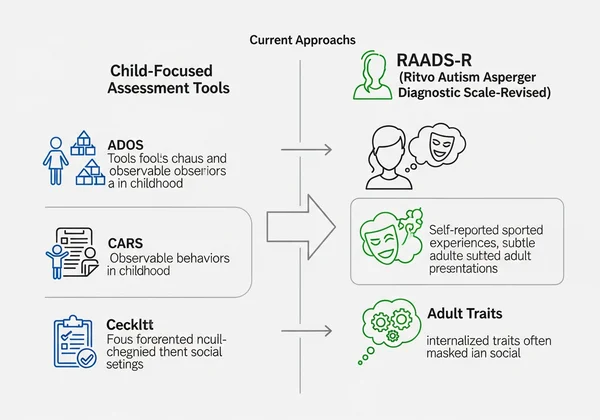
The original RAADS was developed in 2008 by Dr. Ari Ritvo and his team of researchers. They identified a critical gap: most autism assessment tools were designed for children. Adults, especially those who had gone their whole lives without a diagnosis, often presented with more subtle traits. Many had learned to "mask" or camouflage their autistic characteristics to fit in.
The RAADS-R refined the original. It helps clinicians spot adults missed in childhood. These folks might be on the autism spectrum. The test was designed to capture experiences related to social challenges, sensory sensitivities, and intense interests that are common among autistic adults.
Tracing the Evolution of Autism Assessment Tools
The history of autism assessment has evolved significantly over the decades. Early diagnostic methods focused almost exclusively on young children, often with high support needs and observable language delays. This left out a huge population of individuals who were navigating work, relationships, and daily life while feeling fundamentally different, but without the language to explain why.
The creation of tools like the RAADS-R reflects a broader shift in understanding neurodiversity. Researchers and clinicians began to recognize that autism is a lifelong neurotype with a wide spectrum of expression. The RAADS-R was a pioneer in this area, providing a structured way to ask adults about their internal experiences, both in the present and during their developmental years.
From Clinical Settings to Online Accessibility
Originally, the RAADS-R was a paper-and-pencil questionnaire used by psychologists and psychiatrists in clinical settings. However, its value as a self-reflection tool quickly became apparent. Making a version of this assessment available online has democratized access to this valuable resource.
Online platforms provide a private, low-pressure environment for individuals to explore their traits at their own pace. This accessibility helps people gather information and organize their thoughts before deciding whether to seek a formal, professional evaluation. At RAADS-R Test, we are committed to this mission of making self-exploration easier. Our free online RAADSR inspired test brings this scientifically-backed framework directly to you.
Validation Studies & Scientific Rigor of RAADS-R
The most important question about any screening tool is whether it works. The RAADS-R has been the subject of multiple scientific studies to determine its accuracy, reliability, and validity. This scientific rigor is what separates it from informal online quizzes and gives its results weight as a starting point for self-discovery.
How Accurate and Reliable is the RAADS-R Test?
In psychometrics, two concepts are key: reliability and validity.
- Reliability means the test is consistent. If you took it under similar conditions, you should get similar results.
- Validity means the test measures what it claims to measure. In this case, does it accurately identify traits associated with autism?
Research has shown that the RAADS-R has good reliability and validity as a screening tool. Studies show it distinguishes autistic from non-autistic adults. The questions cut ambiguity. They mirror real autistic experiences for meaningful results.
Understanding RAADS-R's Domains: The Science Behind Each Section
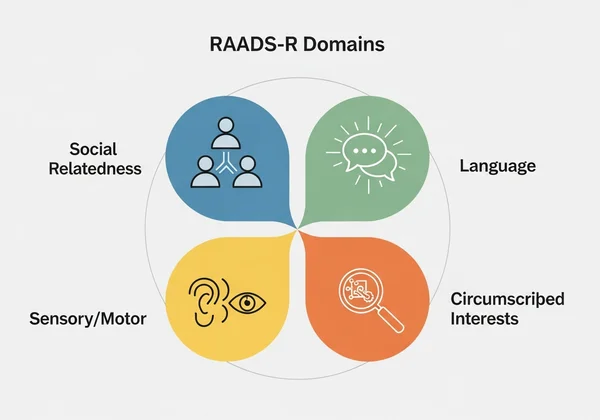
The RAADS-R is composed of 80 questions that are divided into four key domains. Each domain is scientifically designed to assess a core area of the autistic experience.
-
Social Relatedness: This section explores challenges and differences in social motivation, intuition, and interaction. Questions may touch on topics like finding it hard to make or keep friends, feeling like an outsider, or struggling to understand social cues.
-
Language: This domain focuses on the practical use of language (pragmatics). It includes questions about understanding idioms, sarcasm, or conversations with multiple speakers.
-
Sensory/Motor: Many autistic individuals experience the world through a different sensory lens. This section assesses hypersensitivity (being overwhelmed by lights or sounds) or hyposensitivity (needing strong sensory input), as well as motor coordination differences.
-
Circumscribed Interests: This domain relates to having deep, passionate, and highly focused interests, often referred to as special interests. These are a hallmark of the autistic experience and a source of great joy and expertise.
The RAADS-R's Role & Limitations in Self-Assessment
Understanding both the strengths and weaknesses of the RAADS-R is vital for using it responsibly.
Its Role:
- A Starting Point: The test provides a structured framework for self-reflection.
- A Vocabulary Tool: It can give you the language to describe lifelong experiences you may have never understood.
- A Guide for Discussion: The results can be a helpful document to bring to a therapist or doctor to start a conversation.
Its Limitations:
- It is NOT a Diagnosis: This is the most important limitation. A formal autism diagnosis can only be made by a qualified professional after a comprehensive evaluation.
- It Cannot Capture Everything: The test is a snapshot. It doesn't account for co-occurring conditions like ADHD or anxiety, which can overlap with autistic traits.
- Masking Can Affect Scores: Individuals who are highly skilled at masking may score lower, even if they are autistic.
Our platform is designed to help you navigate this process. You can try our free tool to gain initial insights, which can empower you on your path to self-understanding.
Why Scientific Backing is Essential for Your Self-Reflection Journey
When you seek to understand yourself better, the quality of your tools matters. Relying on an assessment with a strong scientific foundation ensures that your journey is built on a solid base of evidence, not on stereotypes or misinformation. This foundation of trust is critical for a meaningful and validating experience.
Building Trust in Online Autism Screening Tools
The internet is filled with "Are you autistic?" quizzes that are often based on popular myths rather than clinical research. These can be misleading and unhelpful. In contrast, using a tool inspired by the RAADS-R means you are engaging with questions that have been carefully developed and tested by experts in the field.
This commitment to scientific principles builds trust. It assures you that the traits being measured are relevant to the actual, lived experiences of autistic adults. It moves beyond caricature and into the nuanced reality of neurodiversity, providing a much more accurate mirror for self-reflection.
The Empathy of Evidence: Validating Experiences Through Research
For many adults, seeing their lifelong feelings reflected in a structured, scientific questionnaire is an incredibly validating experience. It’s the feeling of "This is me. Someone else understands." It transforms vague feelings of being different into a recognized pattern of human experience.
This is the empathy of evidence. The research behind the RAADS-R validates that your experiences are real and shared by others. A high score is not a label but a key that can unlock a new understanding of yourself. Reframe old struggles. They're not failures—just a differently wired brain. That's your first step to self-acceptance and playing to your strengths.

Ready to Dive Deeper? Your Next Steps with RAADS-R Insights
You've seen how the RAADS-R evolved from clinical research to a tool that speaks to overlooked adult experiences. It's not just history—it's a bridge to understanding your own story. By offering a structured language and a reliable framework, it moves beyond casual online quizzes to provide a trustworthy foundation for self-exploration.
Just remember, assessments inspired by the RAADS-R are powerful screening tools, not diagnostic instruments. Their purpose is to empower you with information, give you a vocabulary for your experiences, and offer a clear starting point for discovery. This knowledge helps you decide what's next, whether that's talking to a professional or simply embracing a new way of seeing yourself.
Ready to begin your journey with a tool grounded in science? Start your assessment today to gain valuable, private insights into your unique traits.
Frequently Asked Questions About RAADS-R Scientific Basis
Is the RAADS-R test accurate and reliable for identifying autism traits?
Yes. Studies back it up: The RAADS-R is a reliable and valid screening tool for spotting autism traits in adults. This means the results are consistent (reliable) and it measures what it claims to measure (valid). Its purpose is to be a strong starting point, not a formal diagnosis.
Can the RAADS-R test be used for a formal autism diagnosis?
No, absolutely not. The RAADS-R cannot provide a medical diagnosis. A formal diagnosis of Autism Spectrum Disorder must be conducted by a qualified healthcare professional, such as a psychologist or psychiatrist. The process involves clinical interviews, developmental history, and often input from others. The test is best used as a starting point for self-reflection or to facilitate a discussion with a professional.
How does the RAADS-R compare scientifically to other autism screening tools?
The RAADS-R is one of several well-regarded screening tools, alongside others like the Autism-Spectrum Quotient (AQ) and the Camouflaging Autistic Traits Questionnaire (CAT-Q). Its specific strength lies in its design for adults who may not have been diagnosed in childhood and who may have developed strong coping or "masking" strategies.
Why is it important to understand the scientific background of an online self-assessment like the RAADS-R?
Understanding the science behind a tool like the RAADS-R builds confidence and ensures you are using a credible resource. It confirms that the questions are based on legitimate research into the autistic experience, not on stereotypes. This knowledge helps you trust the insights you gain and use them constructively on your path to self-awareness. To learn more, feel free to explore the resources and take our test.